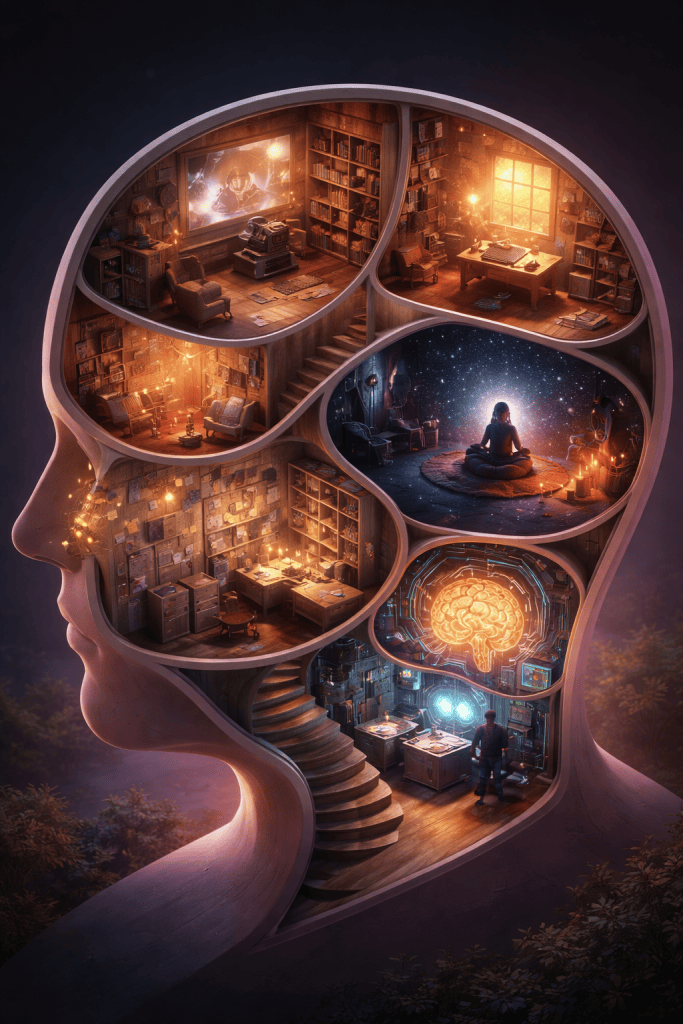
You didn’t land here by accident.
No one ever really does.
Somewhere in the quiet, something in you recognized something in this. Maybe you were looking for a mirror. Maybe you were looking for proof that the way you think isn’t strange at all. Maybe you were just wandering. Either way, here you are.
Let me tell you a story about the rooms inside a human mind.
When we are born, there is nothing labeled yet. No folders. No soundtrack. Just sensation. Hunger feels like the end of the world. Warmth feels like heaven. Everything is immediate. Everything is now.
Then the filing cabinet begins.
By the time you are five, the first drawer is already heavy. Some people build theirs with pictures. The mind runs like a film projector. They remember the yellow of the kitchen walls, the exact way the sun hit the floor, the shirt someone wore when they said something that changed everything. Their thoughts come in frames. Scene after scene. They don’t just recall a moment, they replay it. The rhythm of their life is visual. Patterns show up as imagery. They can see when something feels familiar before they can explain why.
By ten, they’ve learned to pull files quickly. “This feels like that time.” “This looks like that day.” They recognize behavior because it resembles another scene. Their understanding of people is cinematic. The study of human behavior becomes a quiet hobby. They watch. They catalog. They connect dots.
Then there are the ones who don’t see pictures at all.
Close their eyes and it’s black. No faces. No rooms. No color. Just space. Not empty in a scary way. Just blank. For them, memory isn’t a photograph. It’s a sensation. A pulse in the chest. A tightening in the throat. A warmth that says, “safe.” Or a chill that says, “don’t go there.”
Their filing system doesn’t hold images. It holds feelings. They don’t remember what the room looked like. They remember how it made them feel. They don’t replay the argument. They replay the ache. Their pattern recognition is emotional. They sense shifts in energy long before anyone speaks.
By adolescence, another voice enters.
For some, it’s constant narration. A running commentary on everything. “That was smart.” “That was stupid.” “You should have said this.” “Why did you do that?” The inner voice becomes companion or critic depending on how it was shaped. If it was fed encouragement, it becomes guidance. If it was fed shame, it becomes a courtroom.
There are minds that think in language. Full sentences. Paragraphs. Debates. They rehearse conversations that may never happen. They win arguments in the shower. They rewrite the past in better wording. Their power is articulation. Their struggle is silence.
And then there are the ones who think in impulses.
No pictures. No long speeches. Just instinct. A knowing. They move before they explain. They decide before they analyze. It looks reckless to the over-thinkers. It looks peaceful to the anxious. Their mind is less a library and more a compass.
As life moves forward, these systems grow more complex.
The visual thinker refines the reel. They start noticing camera angles. Subtle expressions. The way someone’s smile doesn’t reach their eyes. They see patterns in how people stand when they lie. They read rooms like landscapes.
The emotional thinker becomes fluent in undercurrents. They walk into a space and know who is hurting without being told. They feel the tension before the words surface. Their strength is depth. Their challenge is not absorbing what isn’t theirs.
The verbal thinker sharpens their internal dialogue. They learn to question their own narrator. “Is that true?” “Who taught me that?” If they are brave, they rewrite the script. If they are not, they let the critic run the show.
And the instinctive thinker? They learn, sometimes the hard way, that intuition must be paired with discipline. A compass is powerful, but you still need a map.
Here is what no one really talks about.
None of these ways are wrong. They are adaptations. They are how the nervous system learned to survive, to interpret, to make meaning. The brain is not just an organ. It is an archivist. A storyteller. A protector.
By the time we reach adulthood, the filing cabinet is full. Some drawers are labeled “love.” Some “betrayal.” Some “don’t ever do that again.” We pull from them automatically. We think we are reacting to the present, but often we are responding to an old file that feels similar.
And then one day, if we are paying attention, we pause.
We notice the reel running.
We notice the voice talking.
We notice the feeling rising.
We notice the impulse pushing.
And for the first time, we realize we are not the file.
We are the one opening the drawer.
That is where the story shifts.
Because once you recognize how you think, you gain choice. The visual thinker can stop replaying the same scene. The emotional thinker can separate past feelings from present reality. The verbal thinker can soften the inner critic. The instinctive thinker can slow down long enough to verify direction.
The timeline of a human mind is not about becoming someone else. It’s about becoming aware of the system you’ve been running on autopilot.
Maybe you stumbled here because you wanted to understand your own pattern. Maybe you’ve been wondering why your mind works the way it does. Maybe you were tired of being misunderstood.
Here’s the truth.
Every mind is a room with its own architecture. Some have walls covered in paintings. Some echo with constant narration. Some are wide and dark and quiet. Some hum with raw feeling.
But all of them are trying to do the same thing.
Make sense of the world.
Protect the body.
Find rhythm in the chaos.
And if you’ve read this far, chances are you’re not broken.
You’re just becoming aware of the room you’ve been living in your whole life.


Leave a comment