They underestimated what you could do, who you are.
The first attempt happened before you could speak.
You wouldn’t remember it.
That was the point.
By five, you had already learned to watch people’s faces before listening to their words.
By eight, you understood that love occasionally packed a suitcase.
By twelve, betrayal had introduced itself.
Different houses.
Different people.
Same lesson.
You assumed this was life.
It wasn’t until much later that you noticed the repetition.
The Matrix is terribly sophisticated, but it is not particularly creative.
It recycles.
Same wound.
Different actor.
Same abandonment.
Different door closing.
Same betrayal dressed in a prettier coat.
Every few years it changes the scenery and runs the program again.
Most people never notice.
Old souls do.
Eventually.
That’s why they get it the worst.
They’ve been here before.
Not necessarily in this body.
Not necessarily in this century.
But somewhere beneath the ordinary machinery of consciousness, something remembers the architecture.
And the Matrix knows which ones remember.
So it starts early.
Give someone abandonment and they’ll spend forty years trying to become impossible to leave.
Give them betrayal and they’ll interrogate every person who tries to love them.
Give them rejection and they’ll build an entire life proving their worth to people they don’t even like.
Perfect.
Keep them busy.
Then someone invented therapy.
So we talked.
And talked.
And talked.
We learned attachment styles, trauma responses and nervous systems.
We became extraordinarily educated about the rooms where we almost died.
But nobody suggested going back inside.
Because talking about 1987 from 2026 isn’t time travel.
It’s tourism.
Real time travel requires returning to the scene.
So one night, you do.
Except there isn’t a room anymore.
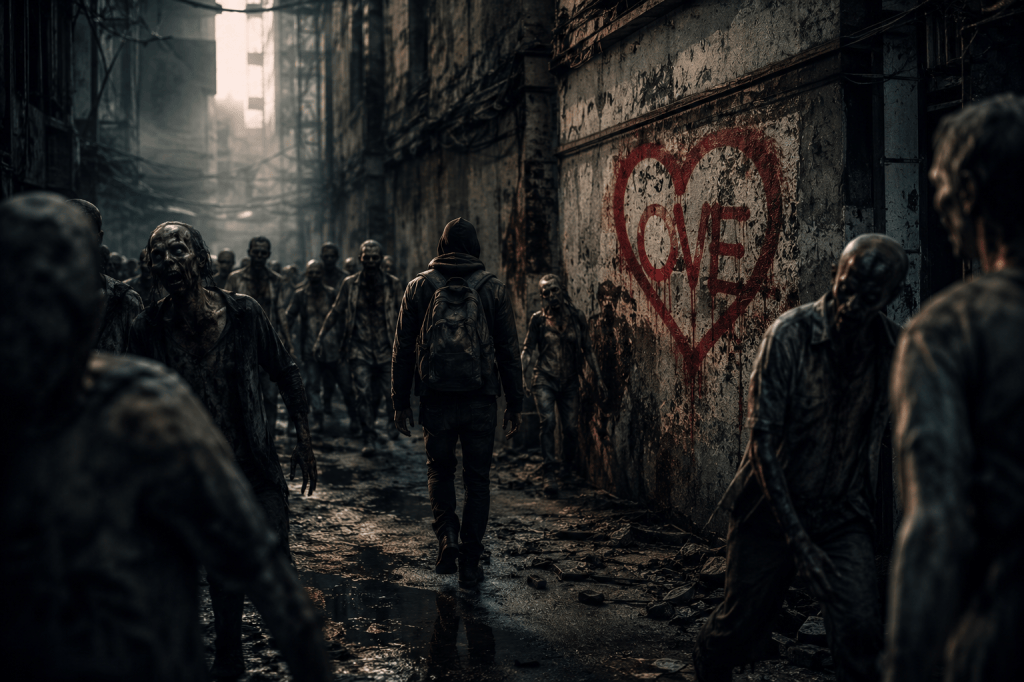
There is a city.
Abandoned.
Windows broken.
Cars left in intersections.
Streetlights flickering over buildings that should have collapsed years ago.
And people are wandering everywhere.
Hundreds of them.
Maybe thousands.
Something is wrong with them.
They move slowly.
Aimlessly.
Some stand beneath windows staring upward.
Others sit against buildings with their heads lowered.
A few scratch endlessly at locked doors.
You keep walking.
None attack you.
That somehow makes it worse.
One turns toward you.
A little girl.
Her dress is filthy. One shoe is missing.
Something about her face stops you.
You know her.
Not from a photograph.
From somewhere deeper.
She is seven.
So were you.
Another appears behind her.
Older.
Twelve, maybe.
Then sixteen.
Twenty-three.
Thirty.
Different faces.
Different clothes.
Different decades.
Same eyes.
Yours.
You finally understand what has been wandering through this place.
These aren’t zombies.
They’re you.
Every version left behind when survival required becoming someone else.
The child who learned not to cry.
The girl who learned not to ask.
The woman who stopped trusting.
The one who became angry.
The one who became useful.
The one who became impossible to abandon because she stopped needing anyone first.
You thought you had healed them.
You had actually outlived them.
And apparently they never left.
One by one, they begin following you.
Not attacking.
Following.
You walk faster.
So do they.
Soon hundreds of footsteps echo behind you.
Then your phone rings.
Someone needs you.
Of course they do.
You ignore it.
It rings again.
Work.
Family.
Love.
Obligation.
Emergency.
The usual machinery.
Anything capable of making you turn around.
You don’t.
At the end of the street is a building with no windows.
You’ve seen it before.
In dreams.
In panic.
In those strange moments when something familiar passes through you without explanation.
The door is unlocked.
Inside is a single room.
And on the far wall is a switch.
Small.
Black.
Almost disappointing.
Beside it:
DO YOU STILL CONSENT?
You hear the zombies gathering outside.
Your zombies.
Your abandoned selves.
The Matrix had convinced you they were wounds.
Things requiring treatment.
Things requiring explanation.
Things you should spend the rest of your life fixing.
But wounds don’t follow you home.
People do.
You open the door.
Hundreds of versions of you are standing in the street.
Then the smallest one walks forward.
The little girl with one shoe.
She reaches for your hand.
And suddenly she isn’t decaying anymore.
Neither are the others.
The dead were never dead.
They were waiting.
That’s when you understand the trick.
The Matrix didn’t need to destroy you.
It only needed to divide you.
Leave enough pieces behind and eventually you would mistake fragmentation for identity.
Keep healing.
Keep searching.
Keep explaining.
Keep blaming.
Keep running.
Anything except turning around and realizing the army following you belonged to you.
You take the child’s hand.
Behind her, another version reaches for another.
Then another.
The dead begin waking.
Not resurrecting.
Remembering.
Somewhere inside the walls, machinery begins screaming.
For the first time, you understand why.
A fragmented person is manageable.
A whole one is dangerous.
You look toward the switch.
For years you thought you needed something from this world.
Love.
Justice.
Closure.
Permission.
An apology.
A reason.
You needed none of it.
You only needed to collect the dead.
Outside, hundreds of your former selves wait for you.
On a crumbling wall someone has spray-painted a heart.
Inside it, almost hidden beneath years of dirt, is one word.
LOVE.
You laugh.
Of course.
The one thing the Matrix could never manufacture without you.
Your finger touches the switch.
Now you remember.
You were never trapped here alone.
You brought an army.
They need you.
(Circles — Of Monsters and Men)


Leave a comment