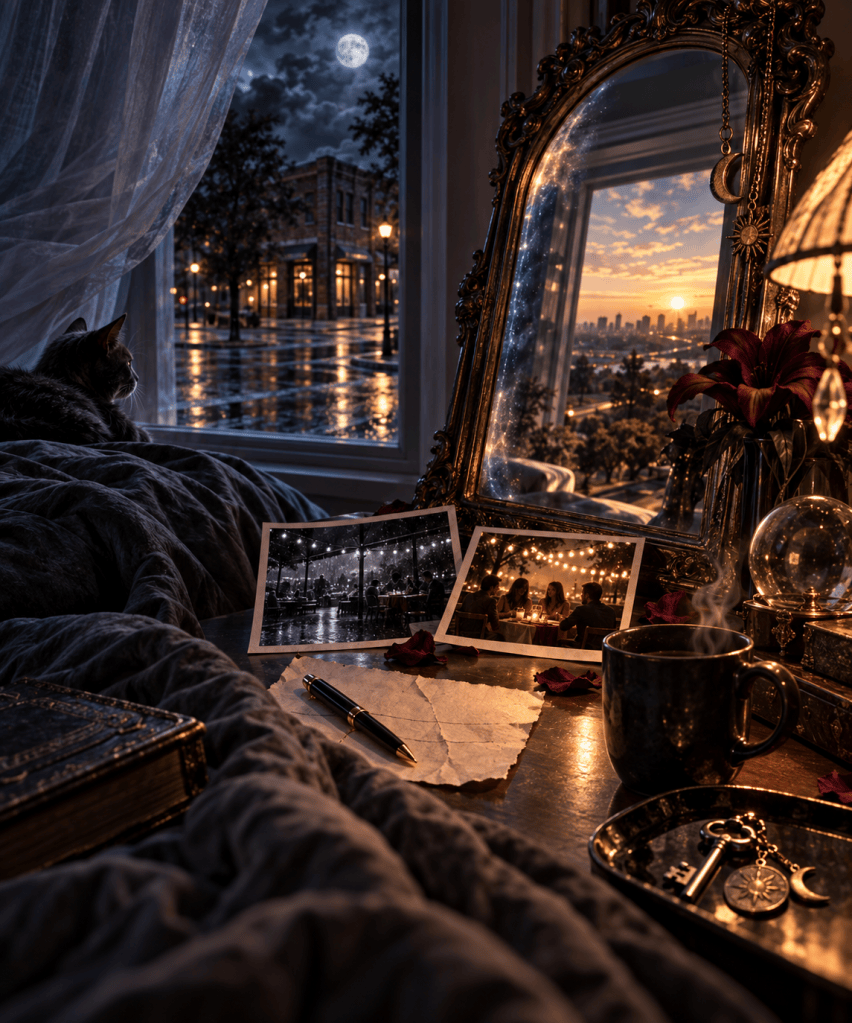
There were rules nobody remembered agreeing to.
The alarm sounded at the same hour each morning, coffee filled the same cup, and traffic gathered beneath the same red lights while hundreds of people stared through windshields toward places they had already been yesterday. Hours became numbers in an account, numbers became houses, cars, groceries, vacations, and small luxuries arranged carefully enough to make the exchange appear fair.
It was not an unpleasant life, which was probably why nobody questioned it.
The first discrepancy appeared on a Monday.
At the intersection passed every morning for nearly eight years, an old brick building stood behind a row of pecan trees. There was nothing remarkable about it except the faded blue advertisement painted across its side and the certainty that it had not been there the previous Friday.
Traffic moved when the light turned green, and by Thursday the building felt familiar.
A week later, a photograph appeared on the phone from a dinner six months earlier. The restaurant was remembered, along with the wine, the terrible service, and the rain that started before dessert. Everyone had crowded beneath the awning while the waiter rescued glasses from the tables.
The photograph disagreed.
Four people sat outside beneath strings of white lights. Their clothes were dry. Behind them, the pavement was pale beneath a summer sky.
The photograph was closed without being shown to anyone.
After that, attention became difficult to turn off.
One morning, the usual road to work was ignored for no particular reason. Three blocks later, traffic stopped beside a little bookstore tucked between two buildings old enough to have stood there for decades.
A single book occupied the center of the window.
Its cover was black, its title strangely familiar, and beneath it was a name that had been signed thousands of times on checks, birthday cards, forms, and receipts.
A horn sounded from behind.
The light had changed.
That evening, the bookstore could not be found.
For several nights nothing unusual happened, which somehow made the ordinary world feel less convincing. The old brick building remained at the intersection. Its faded advertisement became another landmark passed without thought, and eventually there was a vague memory of watching someone repaint the blue lettering several summers earlier.
The memory arrived without invitation.
So did the certainty that it was true.
One night, two routes to work were written on a piece of paper.
Take Preston.
Take Greenville.
The paper was folded once and placed beneath a drinking glass on the kitchen counter. There was a clear memory of writing both lines because Greenville had been misspelled the first time. The pen had stopped halfway through the word, scratched through the mistake, and started again beneath it.
The following morning, Preston was taken.
Nothing happened.
Traffic was heavier than usual. Someone cut across two lanes without signaling. The radio played the same songs it had been playing for months. The old brick building appeared at the intersection exactly where it belonged.
By evening, the experiment seemed ridiculous.
The glass was still on the counter.
The paper remained beneath it.
Inside was one line.
Take Preston.
The handwriting was unmistakable.
The paper was held beneath the kitchen light and turned over. There was no second sentence, no scratched-out word, no indentation from the pen. Even the spacing was wrong. The single line sat comfortably in the center of the page as though nothing had ever been written beneath it.
The paper went into a drawer.
Life continued.
Red lights changed to green. Money moved between invisible accounts. Calendars filled. Packages arrived. The bookstore was eventually remembered as something seen in another neighborhood, although nobody could remember exactly which one. The old brick building had always been on the corner. Everyone knew that.
Months later, the photograph from the restaurant sat framed on the nightstand.
It had been there for years.
Four people stood beneath strings of white lights on the patio, and the evening returned easily when looking at them. The waiter had dropped a fork beside the table. The wine arrived late. Someone told a ridiculous story before dessert that made everyone laugh loudly enough for the neighboring table to turn around.
The fourth person had ordered steak and complained about how badly it had been cooked.
It had been a warm, dry evening.
In the kitchen, the coffee maker began its morning cycle. Outside, traffic collected near the old brick building while the light at the intersection changed from red to green.
The photograph was returned to the nightstand.
Nothing about it seemed unusual.
From somewhere upstairs came the sound of a shower being turned on, followed by water striking tile.
For just a moment, the bedroom smelled like wet pavement.
The window was checked, but the morning outside was clear.
Of course it was.
There had been no rain.
At least, not anymore.


Leave a comment