The knock came before sunrise.
Three slow strikes against the door.
Not desperate.
Official.
The woman inside was already awake.
She had been sitting at the kitchen table with a cup of something that had gone cold hours ago, listening to the wind scrape branches against the roof.
The knock came again.
She did not move.
“Open.”
She recognized the voice.
Everyone did.
She looked toward the hearth.
There were six pieces of wood beside it.
She had counted them last night.
Six.
Enough.
The man outside knocked a third time.
“We need wood.”
This time she smiled.
Not because anything was funny.
Because she had been waiting to hear those words.
She opened the door.
Three men stood on the step.
One held a lantern.
One held a ledger.
The third held an empty cart.
Behind them, morning was beginning to bruise the horizon.
“We need wood,” the man repeated.
“I heard you.”
“For the square.”
“I know.”
He looked past her toward the hearth.
“There is wood inside.”
“Yes.”
“Then bring it.”
“No.”
The man with the ledger looked up.
She had never seen him do that before.
His entire purpose seemed to be writing down what other people had done wrong.
“You are required to contribute.”
She leaned against the doorframe.
“Then write down that I didn’t.”
The scratching of his pen did not come.
For a moment, none of them seemed to know what happened next.
The town had rules for witches.
Rules for adulterers.
Rules for thieves.
Rules for women who spoke too loudly, laughed too freely, healed without permission, refused husbands, buried husbands, inherited land, kept cats, grew herbs, knew numbers, read books, or somehow managed to survive long enough to make someone uncomfortable.
There were rules for nearly everything.
There was no rule for a woman who simply would not hand them a piece of wood.
The man with the lantern stepped forward.
“You watched the last one burn.”
“Yes.”
“You stood in the square.”
“Yes.”
“You brought wood.”
She looked beyond him.
Toward the hill.
She could still remember the smoke.
“I did.”
“Then you understand.”
“I do.”
She began closing the door.
He caught it with his boot.
“The next burning is at noon.”
“Then you’d better find wood.”
She pushed harder.
His boot slipped.
The door shut.
The lock turned.
And that should have been the end of it.
Except the cart remained empty at the next house.
And the next.
At the fourth house, nobody answered.
At the fifth, the door swung open when they knocked.
Inside, there was furniture.
Plates.
A child’s wooden horse beneath the table.
A loaf of bread had gone hard on the counter.
But no people.
At the sixth house, the beds were stripped.
At the seventh, the cupboards were empty.
By the eighth, the man carrying the ledger had stopped writing.
They went to the market.
Half the stalls were closed.
The butcher stood behind his counter staring at an empty space across the aisle where a woman had sold bread every morning for nineteen years.
“Where is she?”
He shrugged.
“Didn’t come.”
They went to the seamstress.
Locked.
The schoolhouse.
Empty.
The washhouse.
Silent.
The apothecary had been cleared so completely that pale rectangles remained on the walls where shelves had once protected the plaster from sunlight.
Someone had taken the jars.
Someone had taken the herbs.
Someone had even taken the broom.
By nine o’clock, the men stopped asking for wood.
They started asking where everyone had gone.
Nobody knew.
Or nobody said.
There had been no meeting.
No protest.
No pamphlets nailed to doors.
No blood painted across the church.
No army gathered beyond the walls.
There hadn’t even been an argument.
That was the strangest part.
The women had simply begun disappearing.
One family on Monday.
Another on Wednesday.
A widow before dawn.
Three sisters after supper.
A mother who tucked her children into bed and then apparently woke them sometime in the night because their blankets were folded neatly at the foot of three empty mattresses.
They had taken what mattered.
Children.
Photographs.
Seeds.
Needles.
Books.
Medicine.
Bread.
And, apparently, every decent axe in town.
By noon, the bell rang anyway.
Because bells do not know when kingdoms are dying.
The accused woman was brought into the square with her wrists bound.
Her name was Sarah.
The charge had changed three times.
First, she had poisoned a man’s crops.
Then someone remembered the crops had failed before she arrived.
So she had bewitched his livestock.
Then his cow recovered.
By morning, the official accusation was simply:
Corruption.
Nobody could explain what she had corrupted.
But the stake had already been built.
Well.
Almost built.
There was a post.
There was rope.
There were officials.
There was a priest.
There were six guards.
There was Sarah.
There was no wood.
The executioner stood beside the stake looking furious, as though the absence of timber were a personal insult.
“Where is it?”
Nobody answered.
“Where is the wood?”
A boy near the fountain shrugged.
His father slapped the back of his head.
The square should have been full.
The last burning had drawn hundreds.
People had climbed onto roofs.
Children had sat on shoulders.
Women had brought bread wrapped in cloth.
Men had passed bottles between them while the condemned woman screamed.
Some prayed.
Some cried.
Some watched.
Some helped.
Some went home afterward and washed soot from their dresses.
Today there were twenty-three people.
Sarah counted.
Then she counted again.
Twenty-two.
Someone had left.
The magistrate climbed onto the platform.
“The execution will proceed.”
The executioner leaned toward him.
“With what?”
The magistrate stared at the empty ground surrounding the stake.
“Find something.”
So they did.
A broken chair from the tavern.
Two fence posts.
A rotten crate.
Someone brought a stool until its owner came running into the square screaming that he wanted it back.
The stool went home.
The magistrate began to sweat.
“Go to the houses.”
“We did.”
“Take the wood.”
“They locked the doors.”
“Break them.”
The guards looked at one another.
That was when Sarah laughed.
It wasn’t loud.
That made it worse.
The magistrate turned.
“Something amusing?”
Sarah looked around the square.
At the shuttered bakery.
The empty schoolhouse.
The abandoned flower stall.
The windows without faces behind them.
“No.”
She looked at him.
“Nothing at all.”
The magistrate ordered her gagged.
A guard reached for the cloth.
Then stopped.
Because somewhere beyond the northern wall came a sound.
A bell.
Not the church bell.
Smaller.
Fainter.
Then another answered it.
Then another.
The people remaining in the square turned toward the road.
Far beyond the town, where the wheat fields disappeared into the hills, tiny figures stood along the ridge.
Women.
Dozens of them.
Then hundreds.
Children beside them.
Carts behind them.
They had not fled.
They had been waiting.
The magistrate’s face changed.
Only slightly.
But Sarah saw it.
Everyone did.
He had thought the town belonged to him.
The women on the ridge began walking.
Not toward the square.
Away from it.
Down the opposite side of the hill.
One disappeared.
Then another.
Then twenty.
Then all of them.
The bells faded with them.
The magistrate turned back toward Sarah.
“Burn her.”
The executioner looked at the broken chair.
The two fence posts.
The rotten crate.
“That won’t burn long enough.”
“Then find more.”
Nobody moved.
The priest looked toward the church.
The butcher looked toward his empty market.
The schoolmaster stared at the abandoned schoolhouse.
And somewhere inside all of them, a terrible little calculation began.
Who would bake tomorrow?
Who would wash the linens?
Who knew which herbs brought down fever?
Who kept the accounts at the market?
Who delivered the babies?
Who taught the children?
Who planted the kitchen gardens?
Who knew where the winter stores were kept?
Who had been doing all the small invisible things nobody thought were power because nobody had ever imagined them stopping?
Sarah watched understanding travel through the square.
It was beautiful.
The magistrate did not see it.
“Untie her,” someone said.
Nobody knew who.
The magistrate spun around.
“What?”
“Untie her.”
This time it came from the butcher.
Then the schoolmaster.
Then someone near the fountain.
Then the executioner.
The magistrate reached for the sword at his waist.
And twenty-one people looked at him.
No one touched him.
No one threatened him.
No one needed to.
The guard beside Sarah cut the rope.
She rubbed her wrists.
Then she stepped down from the platform.
Nobody stopped her.
She walked across the square.
Past the empty market.
Past the shuttered bakery.
Past the schoolhouse where dust was already gathering on the desks.
When she reached the first woman’s house, she knocked.
The door opened immediately.
The woman looked at Sarah’s wrists.
Then toward the square.
“Did they find wood?”
Sarah shook her head.
The woman stepped aside.
Inside, six pieces still rested beside the hearth.
But there were bags near the door now.
A coat.
Boots.
Bread wrapped in cloth.
Sarah looked at them.
“You’re leaving too?”
The woman frowned.
“Leaving?”
She reached for her coat.
Then she looked toward the northern road.
“No.”
Sarah waited.
The woman smiled.
“We’re going home.”
Years later, travelers would find the town mostly abandoned.
They would write stories about plague.
Famine.
War.
One historian insisted the river must have changed course.
Another blamed disease.
None of them understood why the old execution square contained a single blackened post surrounded by perfectly clean earth.
Or why, inside one abandoned house, six pieces of firewood still rested beside a cold hearth.
But several miles beyond the northern ridge, another town appeared on maps around the same time.
Nobody could agree on who founded it.
There was no magistrate’s house.
No execution square.
No stake.
There was, however, a strange tradition.
Every winter, each household placed one piece of wood outside its door.
Not for burning witches.
Not for punishment.
Not for fear.
For anyone who was cold.
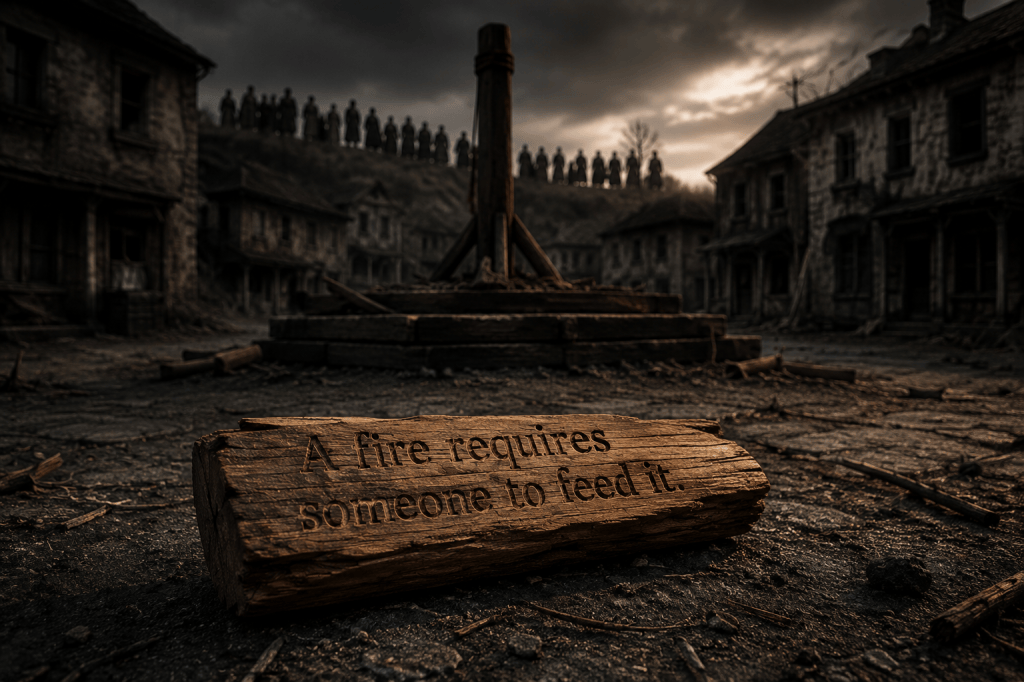
And carved into the oldest door in town were six words.
Nobody remembered who put them there.
A fire requires someone to feed it.


Leave a comment