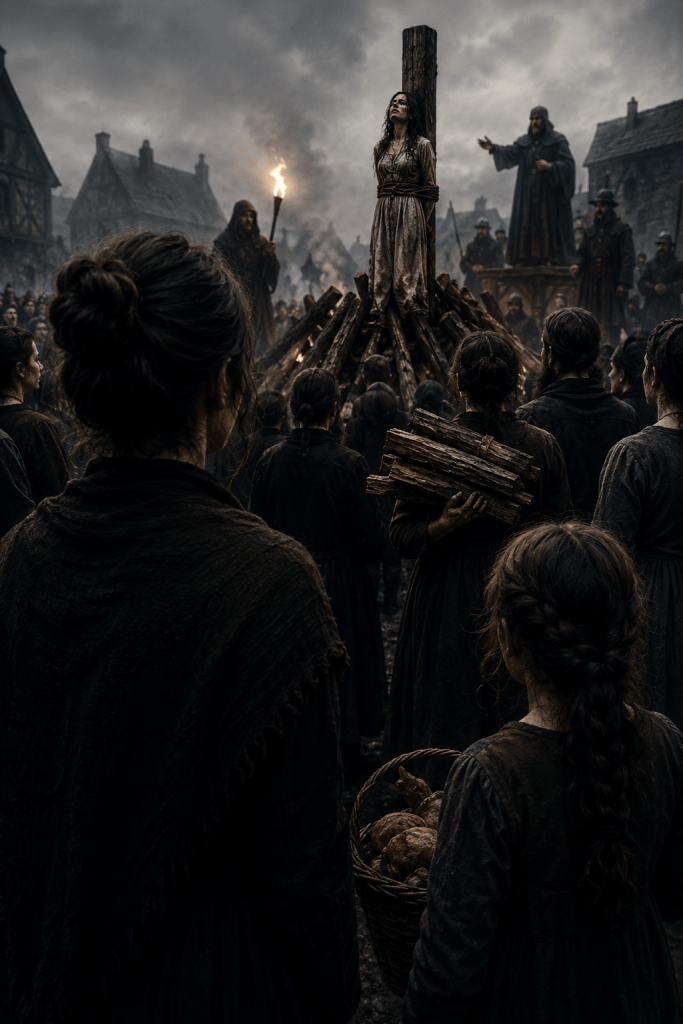
The most dangerous woman at the burning was not the one tied to the stake.
It was the woman standing in the crowd.
She had arrived early.
Before the square filled with bodies. Before the priest climbed the wooden platform. Before the men dragged the accused through the street and explained to everyone why another woman needed to disappear.
She was already there.
Watching.
The morning was cold enough to make breath visible, and someone had stacked the wood carefully around the post.
That was the first thing she noticed.
The wood.
Someone had prepared it.
Someone had carried it here.
Someone had arranged every piece beneath the feet of a woman who was still very much alive.
Funny how nobody ever talks about the preparation.
By the time the crowd arrives to witness the punishment, the punishment has already been decided.
The trial is theater.
The verdict happened somewhere quieter.
The woman pulled her shawl tighter around her shoulders.
Beside her stood another woman holding a basket.
Bread.
Apples.
A small knife wrapped in cloth.
Her daughter stood beside her, perhaps ten years old, holding tightly to the folds of her mother’s dress.
Apparently executions were educational.
“Do you know what she did?” the woman with the basket whispered.
The first woman shook her head.
It didn’t matter.
Nobody really knew.
They had heard things.
She spoke too loudly.
She lived alone.
She knew which herbs stopped a fever.
Someone’s baby survived after she touched it.
Someone else’s didn’t.
She had money despite having no husband.
She had refused a man.
She had laughed at the wrong moment.
She had looked someone directly in the eyes when she should have lowered hers.
There were always reasons.
When a society decides a woman is dangerous, evidence becomes remarkably easy to manufacture.
The woman with the basket leaned closer.
“I heard she bewitched someone’s husband.”
Of course she did.
There was always a husband somewhere who apparently possessed no control over his own decisions.
The first woman almost smiled.
Almost.
But women learned young which expressions were safe in public.
So she kept her face still.
Across the square, another woman appeared carrying three pieces of wood against her chest.
That was what caught her attention.
Not the priest.
Not the guards.
Not even the woman being dragged toward the stake.
The woman carrying the wood.
A little girl walked beside her.
Her daughter, perhaps.
The woman stepped through the crowd and carefully placed the wood onto the pile.
One piece.
Then another.
Then the last.
She brushed the bark from her dress and stepped backward.
Proudly.
As though she had contributed something useful to the community.
The first woman looked at the little girl.
The child wasn’t watching the prisoner.
She was watching her mother.
And there it was.
The lesson.
Not spoken.
Not written.
Not preached from the platform.
Taught.
This is what good women do.
This is what happens to bad women.
And this is how you make sure nobody confuses the two.
Another woman came forward carrying kindling.
Another brought oil.
One pointed toward the accused and shouted something about wickedness.
One spat near her feet.
The little girls watched.
And suddenly the first woman understood something no sermon had ever taught her.
Men may have designed the cage.
But they had convinced women to guard the door.
That was clever.
Almost beautiful in its cruelty.
Because a system becomes nearly impossible to overthrow once the prisoners begin policing one another.
Reward the obedient ones.
Protect them slightly more than the others.
Give them a respectable place beside the fire instead of inside it.
Call them good women.
Proper women.
Women who know their place.
Then show them what happens to women who don’t.
The lesson teaches itself.
The accused reached the stake.
Her hands were bound.
Her dress was torn near the shoulder.
There was blood at the corner of her mouth.
Still, she wasn’t crying.
That seemed to bother people.
They wanted tears.
People prefer their condemned properly broken.
It makes cruelty feel righteous.
The priest began speaking.
Sin.
Temptation.
Corruption.
Purity.
Words that had buried more women than dirt ever could.
The first woman stopped listening.
She watched the crowd instead.
That was where the real story was.
Some women looked horrified but remained silent.
Some whispered prayers.
Some stared at the ground.
Some watched eagerly.
And some looked relieved.
That was the expression she couldn’t forget.
Relief.
Not me.
That was what their faces said.
Not today.
Perhaps that was the oldest bargain women had ever been offered.
Help us choose her, and we won’t choose you.
So they chose her.
Again.
And again.
Different women.
Different accusations.
Different centuries.
Same bargain.
Sometimes the stake became a rumor.
Sometimes the rope became exclusion.
Sometimes the execution happened around a dinner table.
A church pew.
An office.
A family.
A marriage.
Sometimes nobody burned a woman’s body at all.
They simply burned her reputation and invited everyone she loved to bring kindling.
The methods improved.
The instinct remained.
Destroy the woman who refuses to behave correctly.
Then call the destruction morality.
The priest raised his hand.
The square became quiet.
A torch appeared.
The woman at the stake finally lifted her head.
Her eyes moved across the crowd.
Slowly.
Not pleading.
Counting.
That made the first woman’s stomach tighten.
She wasn’t looking for mercy.
She was memorizing faces.
The woman who carried the wood.
The woman who brought the oil.
The woman who pointed.
The woman who spat.
The women who prayed.
The women who watched.
Then her eyes found the first woman.
For one terrible second, neither looked away.
Something passed between them.
Not forgiveness.
Certainly not fear.
Recognition.
The torch touched the kindling.
Flames crawled through the wood.
The crowd stepped backward.
Heat rolled across the square.
Smoke rose toward a sky that had apparently decided not to interfere.
Someone cheered.
Then another.
The woman with the basket crossed herself.
Her daughter stared.
And the woman at the stake looked down.
At the flames.
Studying them.
That was when the first woman understood.
Everyone else thought they were teaching the condemned woman a lesson.
They weren’t.
She was learning theirs.
Fire needed wood.
Wood needed hands.
Hands needed permission.
Permission needed fear.
And fear required everyone standing in that square to believe they might be next.
Remove one piece and the entire ritual failed.
The woman at the stake looked toward the crowd again.
The corner of her mouth moved.
Not enough to call it a smile.
Enough to make the first woman wonder what she had figured out.
The flames climbed higher.
People began leaving before it was finished.
That was another strange thing about public cruelty.
Everyone wants to witness the beginning.
Very few stay for the consequences.
The woman with the basket gathered her daughter.
The priest disappeared.
The guards began talking among themselves.
The woman who had carried the wood took her little girl’s hand and walked home.
Dinner still needed cooking.
Children still needed bathing.
Beds still needed turning down.
Life continued.
It always does.
The first woman stayed.
She stood at the edge of the square until the crowd disappeared.
Until the shouting stopped.
Until the fire became embers.
Until there was nobody left to impress with righteousness.
Then she walked toward the ashes.
The heat pushed against her face.
She looked at what remained.
Charred wood.
Black earth.
Ash.
And near the edge of the fire, untouched by the flames, lay one small piece of wood.
She bent down and picked it up.
Turned it over in her hands.
Nothing remarkable about it.
That might have been the worst part.
It was just wood.
The fire had never been magical.
Neither was the stake.
Neither was the priest.
Neither were the people who had built it.
The entire thing required ordinary hands doing ordinary things while telling themselves they weren’t responsible for the ending.
One woman carried wood.
Another brought oil.
Someone made an accusation.
Someone repeated it.
Someone stayed silent.
Someone struck the match.
And everyone could go home believing the fire belonged to somebody else.
The first woman looked toward the road where the others had disappeared.
Then back at the ashes.
Who killed her?
The priest?
The executioner?
The person who accused her?
The woman who carried the wood?
The woman who brought the oil?
The women who watched?
Perhaps that was why the system worked so well.
Nobody had to carry enough guilt to feel responsible.
Just enough wood to keep the fire burning.
She carried the untouched piece home.
She placed it beside her door.
Not as a memorial.
Not as an apology.
As evidence.
Every morning she passed it.
Every evening she passed it again.
And eventually people forgot about the woman who had burned.
They always did.
There were crops to harvest.
Children to raise.
Meals to prepare.
Men to bury.
Babies to deliver.
Years have a way of making atrocities feel historical while the machinery that created them remains perfectly operational.
But the first woman remembered.
She remembered the priest.
The little girls.
The relieved faces.
The smell of smoke.
Most of all, she remembered the hands.
Ordinary hands.
Women’s hands.
Hands exactly like hers.
And the piece of wood remained beside the door.
Waiting.
Because everyone in the square had been watching the woman burn.
But only one of them had been watching the fire.
And sooner or later,
there would be another knock at the door.


Leave a comment