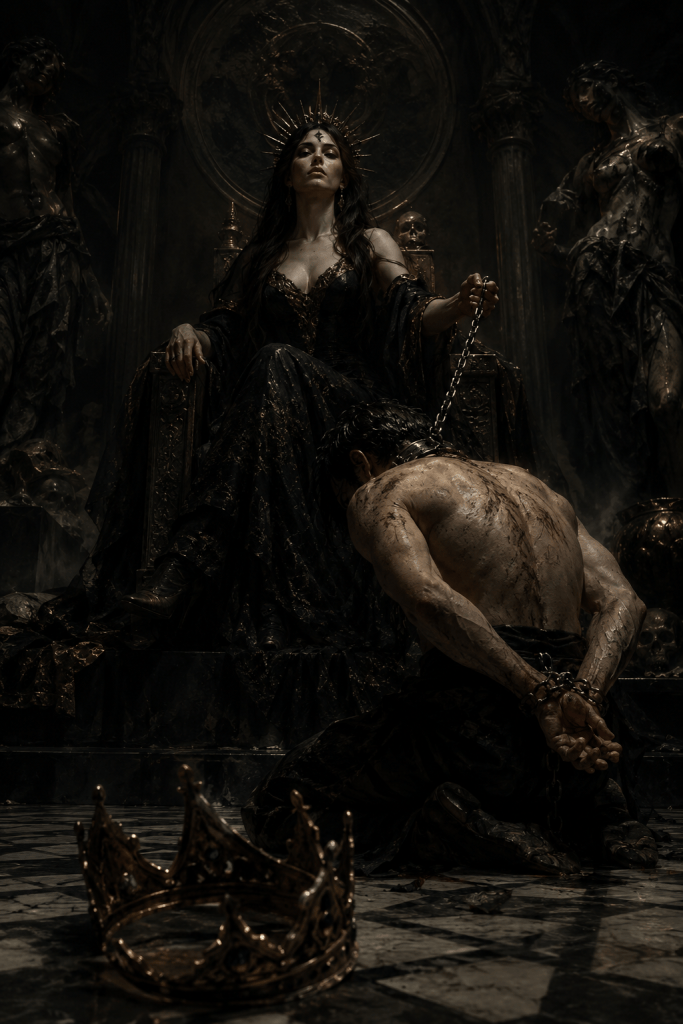
When the creation turns on its creator the world is dark. A woman provides life.
And somehow, man convinced the world that made him that he was the one holding the power.
There is something almost beautiful about the arrogance of it.
He arrived screaming, covered in her blood, entirely dependent upon her body for his existence, and eventually stood upright long enough to declare himself ruler.
Perhaps that was the first coup.
Not the overthrow of a king.
The overthrow of the creator.
Somewhere along the way, the creature looked back at the darkness from which he came and became afraid of it.
Not because it was weak.
Because it was powerful.
It bled without dying.
It created without permission.
It carried knowledge inside a body he could enter but never fully understand.
It could bring him into the world.
And eventually, it could decide she no longer needed him in hers.
That kind of power required management.
So they gave it names.
Hysterical.
Unclean.
Temptress.
Witch.
Whore.
Difficult.
Dangerous.
Crazy.
The words changed depending on the century.
The purpose did not.
If you cannot destroy the thing that frightens you, convince it that it should be frightened of itself.
And they were very good at that.
They built kingdoms where men inherited crowns and women inherited consequences.
They wrote laws.
They wrote scriptures.
They wrote history.
Most importantly, they held the pen long enough to convince generations that the person recording the story must have been the hero.
Funny how that works.
The witch rarely gets to write the account of the burning.
The wife does not write the husband’s family tree.
The woman behind the king becomes a footnote beneath the portrait.
The mother becomes his mother.
The wife becomes his wife.
The daughter becomes his daughter.
Even her name can disappear beneath his.
A lifetime reduced to possession by grammar.
His.
His.
His.
The word echoes beautifully through old houses.
But old houses have walls.
And walls remember everything.
They remember the women who learned when not to speak.
They remember dinners served after arguments no one mentioned again.
They remember bruises hidden beneath sleeves and ambitions buried beneath obligations.
They remember brilliant women pretending not to know things because intelligence could make a man uncomfortable.
They remember money hidden in flour tins.
Letters burned in fireplaces.
Doors quietly locked.
Suitcases never packed.
They remember all the tiny funerals women attended while still alive.
The funeral of the life she might have lived.
The name she might have kept.
The thing she might have built.
The place she might have gone.
The person she might have become.
Power does not always look like a throne.
Sometimes power is convincing someone they cannot survive without you.
And men perfected that architecture.
For centuries, the cage did not need bars.
It needed dependence.
No property.
No vote.
No bank account.
No inheritance.
No respectable life outside the approved one.
No easy escape from a violent husband.
No authority over her own body.
Then call him the provider.
That was the clever part.
Build the cage.
Lock the door.
Keep the key.
Then announce that women require protection.
From whom?
The house becomes very quiet when someone asks that question.
Because every system eventually encounters the question it was designed to prevent.
Why?
Why does he lead?
Why does she obey?
Why is his anger authority while hers is instability?
Why is his ambition admirable while hers is selfish?
Why is his desire natural while hers requires judgment?
Why does God always seem to sound suspiciously like the men interpreting him?
Careful.
That last question has burned women before.
Men have always been fascinated by creating gods in their own image.
Bearded.
Commanding.
Watching.
Judging.
Father.
King.
Lord.
The language matters.
Language always matters.
Give divinity a masculine face long enough and eventually masculinity begins confusing itself with divinity.
Then obedience to men becomes obedience to something higher.
Convenient.
Especially for the men.
But beneath every cathedral, kingdom, courthouse, battlefield and family name lies an inconvenient biological truth no amount of mythology can completely bury.
Every king entered this world through a woman.
Every conqueror.
Every priest.
Every judge.
Every executioner.
Every man who ever stood before a crowd and explained what women were permitted to do with their lives.
All of them began helpless inside the very body they would later attempt to govern.
There is something deliciously gothic about that.
The creation fearing the creator so completely that it spends thousands of years trying to convince her she is powerless.
Maybe that was never hatred.
Maybe it was terror.
Because somewhere beneath all the rules, there was always the possibility she would remember.
And women have long memories.
Not merely their own.
Their mothers’.
Their grandmothers’.
The women whose photographs sit unnamed in boxes.
The women whose recipes survived when their stories did not.
The women called mad because rage was easier to diagnose than oppression.
The women called witches because knowledge in the wrong hands threatened the right men.
The women institutionalized.
Silenced.
Traded.
Married.
Burned.
Beaten.
Dismissed.
And still they kept producing the next generation.
Including the men.
That may be the darkest joke history ever told.
The system depended upon the very thing it attempted to diminish.
But systems become arrogant.
They begin believing their own mythology.
They mistake cooperation for submission.
Patience for weakness.
Love for obedience.
Silence for ignorance.
Until one day the woman looks around the room and realizes something has changed.
She has her own money.
Her own name.
Her own keys.
Her own education.
Her own choices.
Her own door.
And suddenly the old bargain becomes difficult to enforce.
She does not need permission to leave.
She does not need permission to stay single.
She does not need permission to earn.
To own.
To speak.
To refuse.
To choose.
To become.
And that frightens anyone whose power depended upon her having fewer choices.
Because equality feels remarkably like oppression when privilege has always been mistaken for birthright.
So the creation becomes angry.
Something has been taken from him.
Except nothing was taken.
She simply stopped handing it over.
There is a difference.
The throne was never his.
She was merely kneeling.
And there is an enormous difference between knocking a king from his throne and discovering he only looked like a king because everyone else was on their knees.
Perhaps that is why the world feels strange now.
The old spell is weakening.
Women are remembering things they were supposed to forget.
That solitude is not death.
That marriage is not salvation.
That motherhood is not servitude.
That femininity does not require obedience.
That love without respect is merely another beautifully decorated cage.
That being wanted is not the same as being valued.
That a man does not become powerful simply because a woman becomes smaller beside him.
And most dangerously:
That she can leave.
There is the forbidden knowledge.
Not hatred of men.
Freedom from requiring one.
Those are entirely different things.
A woman can love a man deeply and still refuse to worship him.
She can build beside him without building beneath him.
She can choose him without needing him to survive.
And perhaps that is what power should have been all along.
Not domination.
Choice.
But those accustomed to domination rarely recognize choice as peaceful.
To them, a woman standing upright looks like rebellion.
So let them call it rebellion.
Women have survived worse names.
There will always be men who understand this.
Men who do not require a woman to shrink so they can feel tall.
Men who do not confuse leadership with ownership.
Men who can stand beside power without needing to conquer it.
They were never the ones who needed the cage.
The others will rattle the bars long after discovering they are standing on the wrong side of them.
Because the cruelest thing about controlling something powerful is eventually teaching it exactly what control looks like.
Then one day it recognizes the pattern.
The creator looks at the creation.
The creation looks back.
Neither is innocent anymore.
But only one of them has spent centuries being told to lower her eyes.
This time she doesn’t.
The room darkens.
The old gods become nervous.
Somewhere, a crown hits the floor.
And the woman who provided life finally remembers something the world worked very hard to make her forget.
She was never created from his rib.
That was his story.
He came from her body.
And perhaps the creation should have been more careful about teaching its creator how monsters behave.


Leave a comment