Actually, I’m my mother’s revenge.
The voice she didn’t have, the boundaries she couldn’t keep, the consequence nobody expected when they mistook her kindness for permission.
Her story isn’t yours to tell.
But tell them all I’m coming.
Not for blood.
That would be too easy.
I am coming for the things women like her were taught to surrender quietly.
The words swallowed at dinner tables.
The anger folded neatly beneath clean towels.
The no that became fine because explaining herself was more exhausting than simply enduring it.
The apologies she gave for things she did not do.
The doors she should have closed.
The people she should have left standing on the other side of them.
My mother belonged to a generation of women taught that keeping the peace was somehow more honorable than keeping themselves.
So they kept everyone else comfortable.
And called it love.
They carried entire families across their backs and were criticized for walking too slowly. They remembered birthdays, buried parents, raised children, forgave husbands, tolerated relatives, stretched money, cleaned houses, went to work, came home, made dinner, and somehow still found themselves explaining why they were tired.
They were expected to be soft enough to forgive anything.
Quiet enough not to embarrass anyone.
Strong enough to survive everything.
And grateful enough never to mention the cost.
My mother could be fierce.
God, she could be fierce.
But even fierce women inherit cages.
Some are made of iron.
Others are made of obligation.
The second kind is harder to recognize because everyone compliments you for staying inside.
She’s such a good woman.
Sometimes that sentence is nothing more than a prettier way of saying:
She tolerates things I never would.
I watched.
Children always watch.
We learn relationships before we understand them. We study the adults around us like scripture, memorizing which footsteps mean anger, which silence means trouble, which smile is real, and which one has been placed carefully over something bleeding.
And eventually the daughter grows up.
That is the part nobody plans for.
The little girl in the corner becomes a woman with a memory.
She remembers what her mother forgave.
She remembers what people took.
She remembers who arrived empty-handed and somehow left carrying pieces of her.
And she remembers the strange ceremony of watching a woman make herself smaller so everyone around her could remain exactly the same size.
Except I did not inherit that part correctly.
Something mutated in transmission.
Where she had patience, I developed limits.
Where she gave another chance, I learned to count.
Where she worried about hurting feelings, I started worrying about what happens when people are never allowed to experience the consequences of their own behavior.
My mother taught me compassion.
Life taught me where to stop using it.
Perhaps that is the inheritance nobody talks about.
Maybe daughters are not supposed to repeat their mothers.
Maybe we are supposed to finish something.
Maybe every generation carries the unfinished sentence of the women before it until eventually one of us has enough nerve to place the period.
No.
There.
A complete sentence.
No explanation following behind it like a frightened servant.
No paragraph defending the decision.
No committee meeting.
No appeal.
No guilt.
Just no.
You should see how uncomfortable people become when a woman discovers that word.
Especially people who benefited from her never using it.
Suddenly she has changed.
Suddenly she is difficult.
Cold.
Selfish.
Angry.
Unreasonable.
They will diagnose her personality before they examine their behavior.
They will mourn the version of her who allowed access without accountability.
They will say they miss who she used to be.
Of course they do.
The old version was convenient.
But somewhere beyond this life, I imagine my mother watching all of it.
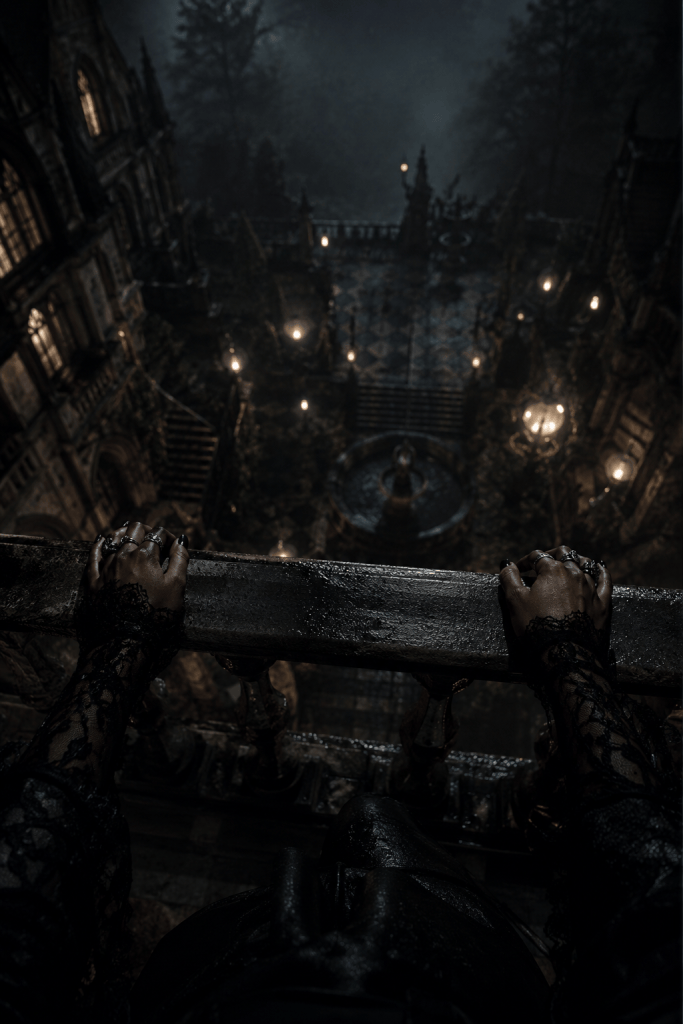
Perhaps there is a great dark balcony between worlds where the women who came before us gather at night. Mothers and grandmothers and women whose names disappeared into marriage certificates and family Bibles.
Perhaps they lean over the railing when one of us finally says the thing they were too afraid to say.
Perhaps they whisper:
Again.
So I do.
I say no again.
I leave again.
I choose myself again.
I disappoint someone again.
I become the villain in another person’s story because I refused to die politely in mine.
Again.
Again.
Again.
Not because I am cruel.
Because somewhere along the bloodline, cruelty became confused with refusing to tolerate cruelty.
I am correcting the translation.
My mother’s life was hers.
Her mistakes were hers.
Her loves were hers.
Her secrets belong to the grave if that is where she wanted them.
I will not turn her into a saint because she died. She was human. Complicated. Beautiful. Infuriating. Loving. Imperfect.
She belonged to herself.
That is why her story isn’t yours to tell.
And it isn’t entirely mine either.
I only own the part where her story collided with mine.
The inheritance.
The aftermath.
The daughter standing in the doorway after the funeral realizing death has a strange way of rearranging the furniture inside you.
You start asking different questions.
Why am I tolerating this?
Who taught me I had to explain myself?
Why am I carrying people perfectly capable of walking?
Why am I protecting people from consequences they personally ordered?
And the most dangerous question of all:
What would my life look like if I stopped being afraid of disappointing people?
That question has teeth.
Once it bites, there is no returning to sleep.
So perhaps revenge is the wrong word.
Perhaps resurrection is closer.
Because I am not here to punish everyone who ever failed her.
I am here to refuse the inheritance of silence.
I am here to burn the contracts she never signed but somehow spent a lifetime honoring.
I am here to return guilt to its rightful owners.
I am here to love people without becoming responsible for them.
I am here to understand that forgiveness does not require renewed access.
That history does not guarantee a future.
That blood can knock on the door and still remain outside.
That love without boundaries eventually becomes a burial.
And I have already attended enough funerals.
So when they say I am different, I smile.
When they say I have become harder, I let them.
When they whisper that I think I am too good for certain rooms, I remember how many women before me stayed in rooms that were killing them because leaving would have made someone uncomfortable.
Let them be uncomfortable.
My mother spent enough time making everyone comfortable.
The debt has been paid.
I am not collecting what the world owes her.
I am spending what she left me.
Her fire.
Her stubbornness.
Her laughter.
Her mistakes.
Her warnings.
Her unfinished sentences.
Her almosts.
Her I should haves.
Her maybe laters.
All of it lives here now.
And when I stand at the edge of something she might have feared and choose myself anyway, I like to imagine somewhere beyond the veil she recognizes exactly what she created.
Not a replica.
Not a monument.
Not a grieving daughter frozen beside an urn.
A continuation.
A correction.
A woman who finally understands that honoring her mother does not mean becoming her.
It means going farther.
So her story can rest.
I’ll carry mine from here.
And should anyone confuse my kindness for the same silence they once depended upon, they are welcome to make that mistake.
Once.
Because my mother raised the daughter.
But life sharpened her.
And if somewhere in the darkness the women before me are still watching from that balcony, waiting to see what happens next, they can come closer to the railing.
This is the part they never got to see.
The daughter has the voice.
The daughter knows where the door is.
The daughter is no longer afraid to close it.
And tell them all I’m coming.
Not to avenge the woman my mother was.
To become the woman she never had permission to be.


Leave a comment