
There are those who play with fire assuming their lies cause fear forgetting your truth is what causes theirs.
There was once a paradoxical arrangement between heaven and earth, one in which the righteous were permitted to measure the wicked, provided no one examined the hands holding the scales.
It was an arrangement of remarkable convenience.
For centuries, mankind had labored beneath the comforting illusion that sin possessed a hierarchy. Certain transgressions were said to weigh more heavily than others, although the measurements appeared to change according to the reputation of the accused. A lie whispered beneath a cathedral ceiling was apparently less offensive than a truth spoken beneath an autumn moon.
And so the scales were fashioned, not of iron or gold, but of preference.
The congregation gathered faithfully each Sunday, dressed in their finest garments, carrying the burdens of Saturday evening beneath freshly pressed collars. Their prayers ascended with admirable conviction, although their treatment of the unfortunate souls serving their Sunday brunch seldom reflected the mercy they had so recently requested.
There was something almost theatrical about it.
The acclaimed prophet had once preferred the company of beggars, thieves, and prostitutes. He had broken bread among the condemned and extended his hands toward those whom respectable society considered unworthy of touching.
Perhaps he understood something his admirers had forgotten.
Perhaps salvation had never required an audience.
Yet there they stood, the newly redeemed, reciting their innocence before a room full of observers, while the sinner sat quietly among innocent witnesses, possessing neither the appetite nor the vanity to announce a private conversation with heaven.
One could scarcely imagine a more exquisite contradiction.
And what, precisely, had the righteous been saved from?
Themselves?
Such questions were considered terribly impolite.
Especially when the autumn winds began their mournful passage through the dying branches and the ancient celebrations returned to the earth.
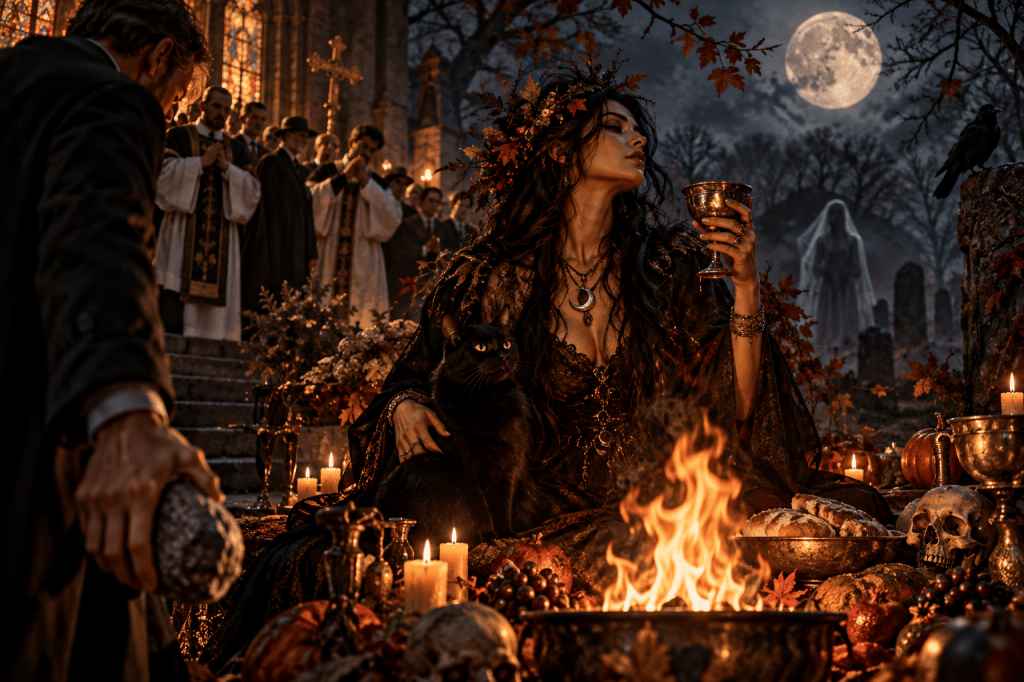
For somewhere beyond the cathedral, beneath the bruised October sky, a witch prepared her fire.
She had no congregation to impress, no collection plate to fill, and no interest in persuading the heavens that her existence deserved special consideration.
She welcomed Samhain as her ancestors had welcomed the turning seasons. The sun withdrew its golden fingers from the land, and darkness approached with the familiar tenderness of an old lover returning from a distant country.
The veil, it was said, grew thin.
A place was prepared for the departed. Bread was broken, wine was poured, and the names of those who had passed beyond the reach of mortal hands were spoken into the evening air.
There was no terror in her ceremony.
Only remembrance.
And yet, somewhere in the distance, a righteous man condemned her fire while lighting a candle of his own.
How curious that one flame should be sacred and another damned.
How offensive that offerings upon one altar were devotion, while offerings upon another were evidence of wickedness.
Perhaps the difference had never been the ritual.
Perhaps it was merely the authority of the hands performing it.
Long before the cathedral bells disturbed the morning silence, mankind had knelt before the changing seasons, studied the heavens, gathered medicinal plants, and sought meaning in the mysteries of birth and death.
The old ways had names long before the newer kingdoms gave them different ones.
But history was an inconvenient guest at the table of absolute certainty.
It remembered too much.
It remembered the healers whose knowledge grew from roots and flowers, the women who tended fevered children, the midwives who welcomed life into the world, and those who understood that nature could both nourish and destroy.
Some were revered.
Others, in darker centuries, were accused of possessing powers that frightened the very people who had once sought their assistance.
Their knowledge became suspicious. Their independence became dangerous. Their ceremonies became evidence.
And eventually, their fires were no longer their own.
There was an extraordinary cruelty in condemning a woman for speaking to the unseen while kneeling before an altar to request precisely the same privilege.
But contradiction had always been an obedient servant of power.
The witch, meanwhile, continued her preparations.
She crushed the herbs between her fingers and watched their fragrance rise through the evening. She knew the language of the seasons, the patience of the soil, and the deafening silence that sometimes arrived before an event had announced itself.
Whether her gifts came from intuition, experience, or something the ordinary senses could not explain was of little consequence.
She had never demanded that another soul believe.
The righteous, however, required considerably more cooperation.
They wished not merely to worship their god, but to determine which gods their neighbors might address, which ceremonies were permissible, and whose understanding of the divine deserved punishment.
They had fashioned heaven into a kingdom of obedience and earth into its courtroom.
And in their devotion to judgment, they had overlooked the possibility that paradise was something they might have cultivated beneath their own feet.
There was a time when a question could cost a woman her life.
Was the Nazarene a miracle worker, a healer, or a magician in the language of those who witnessed him? Was Mary merely a figure in the sacred account, or had centuries of interpretation concealed mysteries no historian could fully recover?
Questions were dangerous things.
They threatened the comfort of conclusions inherited without examination.
And heaven, it seemed, had acquired a remarkable number of earthly representatives willing to punish curiosity on its behalf.
Still, the witch did not argue.
She placed another piece of wood upon the fire.
The flames rose, illuminating the silver ornaments at her throat and casting restless shadows across the earth. Above her, the stars occupied their ancient positions, indifferent to the borders mankind had drawn between one faith and another.
She considered the old Hermetic words.
As above, so below. As within, so without.
Perhaps the heavens had never been as distant as men imagined.
Perhaps the paradise they begged to enter had been waiting for them to practice its virtues while they were alive.
And perhaps the greatest sin was not disbelief, witchcraft, or the invocation of an unfamiliar name.
Perhaps it was the deliberate corruption of something sacred for the pleasure of possessing authority over another.
The fire crackled.
Across the valley, the cathedral bells began their evening lament.
The witch raised her glass to the departed, honoring those whose voices had been silenced by centuries of fear. Somewhere beyond the darkness, the names of the forgotten seemed to move among the trees.
She did not ask them to return.
She merely made room for their memory.
And as the final bell surrendered to the night, a figure emerged from the shadows carrying a stone.
He approached the fire with the solemn expression of a man convinced that heaven had entrusted him with the punishment of another.
The witch looked at the stone, then at the trembling hand that held it.
She recognized him.
He had stood among the congregation that morning, speaking eloquently of forgiveness.
For a moment, neither moved.
Then she reached toward the fire and offered him a place beside it.
He remained standing.
For there was one passage of scripture he had never quite learned to endure.
Let him who is without sin cast the first stone.
The stone grew heavy in his hand.
And beneath the same indifferent stars that had witnessed the birth of every religion, the witch waited.
She had brought enough bread for two.
So mote it be.

