
One only needed to look to the sky to know the tension in the air.
The clouds had gathered in peculiar formations, their dark bellies swollen beneath an autumn moon that appeared almost too large for the heavens. A restless wind carried the fragrance of dying roses through the grounds of an ancient estate, where a gathering of considerable importance had been arranged.
The invitations had arrived without explanation, each bearing a single sentence in elegant black ink.
Come as you truly are.
Naturally, everyone arrived disguised.
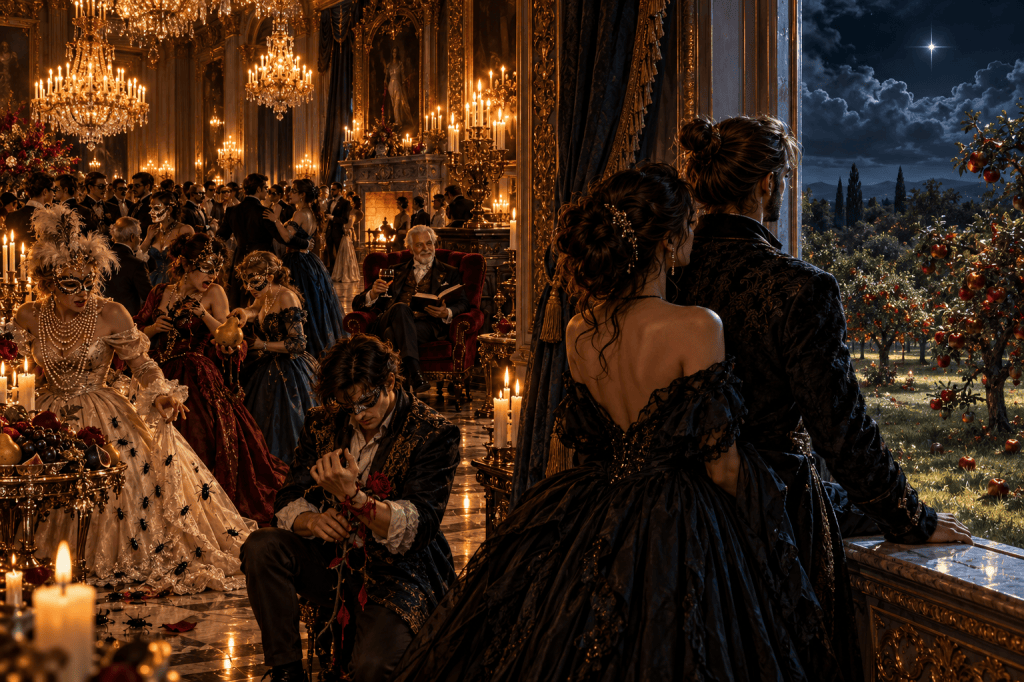
The ballroom glittered beneath a thousand candles. Silk brushed against velvet, diamonds caught the trembling light, and laughter rose from painted mouths whose owners had long ago perfected the art of appearing delighted.
An elderly gentleman occupied a velvet chair beside the fireplace. His silver hair was neatly combed, his evening attire immaculate, and upon his lap rested a small book bound in weathered leather.
He had been watching the company for some time.
“An impressive collection,” remarked a woman seated nearby.
“Indeed,” he replied. “Although I fear several of the specimens have been mislabeled.”
She laughed, uncertain whether she had heard a compliment.
A gentleman dressed in burgundy approached the refreshment table, where a magnificent arrangement of pears, figs, and dark grapes had been placed beneath a silver candelabrum.
He selected the largest pear.
The fruit collapsed between his fingers, leaving behind a foul-smelling pulp.
“How revolting!”
“Perhaps try the grapes,” suggested the elderly gentleman.
The gentleman did.
They were equally spoiled.
Strangely, the fruit remained beautiful to everyone else.
Across the ballroom, a woman adorned in pearls was entertaining a small circle with a story she had told many times before. Her audience listened politely until a astounding sound interrupted her.
A faint scratching.
She continued speaking.
The scratching grew louder.
It seemed to come from somewhere beneath her elaborate gown.
When she lifted the hem, dozens of tiny black beetles scattered across the marble, disappearing beneath the skirts of her companions.
The musicians did not miss a note.
“How dreadful,” whispered one of the ladies.
“Quite,” replied another, discreetly examining her own sleeves.
Near the windows stood a young gentleman who had spent much of the evening admiring a rose he had taken from the centerpiece. He held it close to his lips, occasionally glancing toward an empty place among the dancers.
He had not noticed the thorns growing longer.
By the time he felt them, the stem had wound itself around his wrist.
He pulled away, leaving a few drops of blood upon the white linen of his cuff.
The elderly gentleman turned a page in his book.
“Such a troublesome flower,” he murmured. “Particularly when plucked from another’s arrangement.”
As the evening progressed, other peculiarities emerged.
A woman discovered that her pearls had become dull stones. A gentleman found that every coin in his pocket bore the face of a stranger. Two companions who had spent years exchanging affectionate whispers suddenly found their voices reduced to the faintest rasp whenever they attempted to speak to one another.
Yet the orchestra played beautifully.
And the candles burned without diminishing.
At eleven minutes before midnight, the elderly gentleman closed his book.
“Ah,” he said softly. “There they are.”
No announcement followed.
A woman in a gown the color of midnight had appeared at the edge of the ballroom. Her hair was loosely gathered, with a few rebellious strands resting against her neck. She wore no jewels beyond a delicate silver ornament at her throat.
A gentleman stood beside her.
He leaned toward her and whispered something that caused her to smile with such unguarded amusement that several nearby conversations faltered.
“Do you suppose they know?” asked the woman in pearls.
“Know what?” replied her companion.
But neither could quite explain the sudden discomfort that had settled between them.
The gentleman offered his hand.
His companion accepted.
And the waltz began.
There was something curious about the way they moved together. Not the practiced precision of accomplished dancers, but the ease of two people who had once learned the same melody and remembered it after many years apart.
She occasionally anticipated his steps.
He seemed to know when she would laugh.
Once, she stumbled slightly, and he steadied her with a tenderness so familiar that she barely noticed the interruption.
The elderly gentleman watched them over the rim of his glass.
“How long have they known one another?” asked a lady whose elaborate feathered mask had begun to shed.
“Long enough.”
“Are they promised?”
“That depends upon whom you ask.”
“Well, surely someone must know.”
The gentleman smiled.
“Someone always does.”
Beyond the tall windows, the orchard stirred beneath the Hunter’s Moon.
The branches of the oldest trees hung low with fruit, although the gardeners had insisted only that morning that the harvest was finished.
One apple, red as a freshly sealed letter, fell silently into the grass.
Then another.
And another.
The elderly gentleman appeared pleased.
Meanwhile, the ballroom had become a rather uncomfortable place for certain members of the company.
The woman in pearls found that her chair had grown inexplicably small. Each attempt to settle herself resulted in another inch of velvet disappearing beneath her.
The gentleman in burgundy complained of an insatiable thirst, though every glass he raised to his lips was empty before he could drink.
The young man with the rose had ceased struggling against its thorns. He sat quietly, watching the dancers while the flower slowly turned brown against his wrist.
No one seemed particularly inclined to assist him.
At the center of the room, the woman in midnight rested her hand upon her companion’s shoulder.
“Do you remember?” she asked.
“Which part?”
“The beginning.”
He looked at her for a long moment.
“I remember thinking I would never forget it.”
She lowered her eyes, smiling.
“And did you?”
“Not a day.”
The orchestra softened.
For a brief moment, the room seemed to recede around them, leaving only the quiet movement of their bodies and the golden light upon her face.
He brushed a loose strand of hair from her cheek.
“You have changed,” he whispered.
“So have you.”
“Do you mind?”
She considered him with the thoughtful expression of a woman who had lived enough to understand that some questions deserved more than a hurried answer.
“No,” she said at last. “I rather like who you have become.”
He kissed her forehead.
And somewhere beyond the windows, the first of the orchard’s branches broke beneath the weight of its fruit.
A sharp crack startled the company.
The elderly gentleman chuckled.
“An abundant year, after all.”
The clock began its approach to midnight.
The musicians played on, though several of the guests had grown strangely quiet. The woman in pearls had lost the last of her ornaments. The gentleman in burgundy stood beside a table laden with untouched food, unable to satisfy his hunger.
And the young man with the rose?
He had finally released the stem.
It lay upon the marble, a withered thing whose thorns had never belonged to him.
At the fireplace, the elderly gentleman opened his book once more.
A lady approached him, her curiosity having overcome her discomfort.
“Forgive me, sir, but I have been watching you all evening.”
“Have you?”
“You seem terribly familiar with everyone.”
“Not everyone.”
“Then whom?”
He glanced toward the dancers.
“Those two, for instance.”
The lady followed his gaze.
“Are they important?”
“To one another, certainly.”
“That is not what I meant.”
“I know.”
She frowned.
“Have you known them long?”
The elderly gentleman ran one finger along the edge of a yellowed page.
“I was there the first day the heart opened.”
“Whose heart?”
He looked at her with an expression of almost affectionate disappointment.
“My dear, you have spent the entire evening asking questions of a story you have not bothered to read.”
She straightened indignantly.
“And I suppose you have read it?”
“Several times.”
“Then tell me how it ends.”
The elderly gentleman turned the book toward her.
The final page was blank.
She gave a triumphant little laugh.
“Well, there you are. Even you cannot know.”
He closed the book gently.
“How curious that you should mistake an unwritten page for an uncertain ending.”
The lady had no reply.
Across the room, the lovers had abandoned the waltz and were standing together near the windows. Beyond them, the Hunter’s Moon illuminated the orchard, where the fallen fruit lay scattered like small offerings upon the earth.
The woman rested her head against the gentleman’s shoulder.
“Look,” she whispered.
He followed her gaze.
High above the orchard, two stars had emerged from the clouds, so close together that their light appeared almost joined.
“Beautiful,” he said.
She smiled.
“I was thinking the same thing.”
The elderly gentleman rose, placing his book beneath one arm.
The clock struck midnight.
At once, every candle in the ballroom bent its flame toward the lovers.
Not one was extinguished.
The company fell silent.
The elderly gentleman paused beside the fireplace and withdrew a fountain pen from his breast pocket. Its silver nib caught the last amber reflection of the moon.
He opened his book to the final page.
For a moment, he seemed to hesitate.
Then he smiled, as though remembering a promise made so long ago that even the stars had forgotten the occasion.
He wrote a single sentence.
What has been written like ink upon a blank page shall be done.
Outside, the two stars disappeared behind a passing cloud.
When they emerged, there was only one.
And somewhere in the heavens, something opened its eyes.

