
Honesty is only appreciated when aimed at someone else, it tramples over contradictions.
Deep within the forsaken valley of Sleepy Hollow, where autumn mist crept between crooked gravestones and ancient oaks bowed beneath the weight of forgotten sorrows, there existed a legend the villagers spoke of only when the candles burned low.
They told of a rider without a head, condemned to wander the wooded roads beneath an October moon. His black steed thundered across the covered bridge, its iron hooves striking the earth with the dreadful rhythm of a heart buried alive.
No one knew whom he sought.
Some claimed he hunted the wicked. Others believed he searched for the head stolen from him centuries before. Yet there were those who walked the forest at midnight and returned untouched, while others vanished beneath the very same moon.
The dead, it seemed, were particular about their company.
On one bitter October evening, a woman entered the forest carrying a lantern and a sorrow she had rehearsed so often that even she could no longer distinguish its beginning from its invention.
She had loved once, or so she told the villagers. A love of magnificent promises and cruel disappointments, of devotion offered and devotion withheld. The gentleman had abandoned her, though the circumstances of his departure changed whenever the tale was told.
In her possession she carried a faded letter, its edges softened by years of handling. She had read it a thousand times, always finding fresh evidence of his betrayal.
Yet she never read the final page.
That evening, she had followed the footsteps of a stranger into the woods, convinced that somewhere beyond the covered bridge lay another secret requiring her discovery.
The forest grew unnaturally still.
Even the wind appeared reluctant to disturb the leaves.
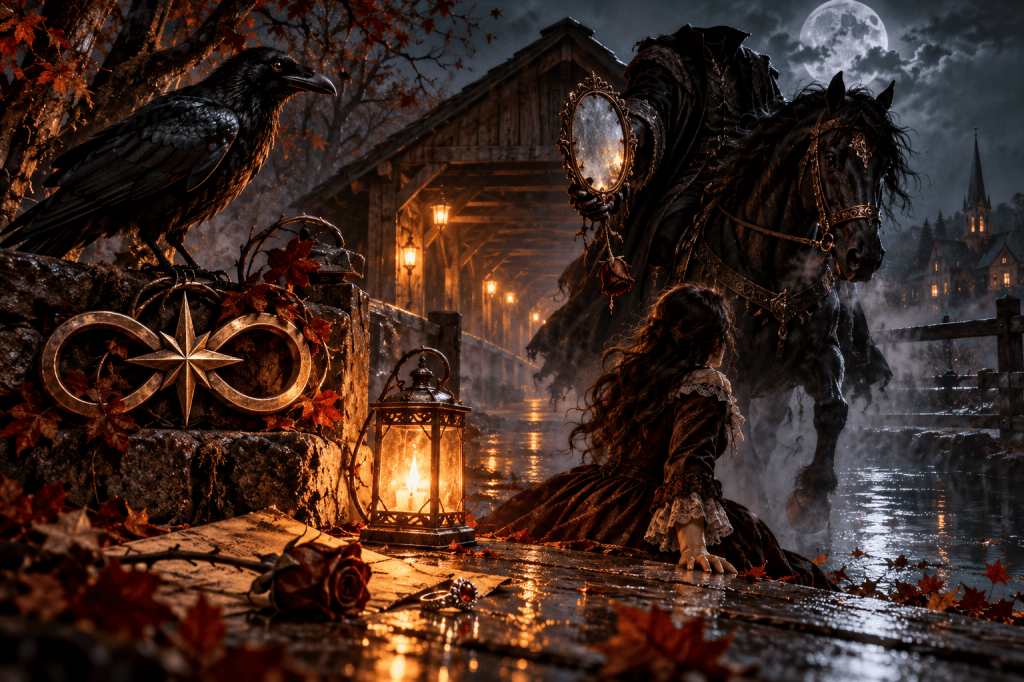
Beneath an ancient willow stood a black horse, its breath rising like funeral incense. Upon its back sat a rider cloaked in darkness, his shoulders supporting nothing but the cold October air.
From his saddle hung a single withered rose.
The woman recognized it.
Years before, a gentleman had placed such a flower upon her windowsill, promising that his affection would endure long after its petals surrendered to winter.
She had kept the rose until another admirer arrived.
Then she had thrown it into the fire.
The Horseman extended one gloved hand. Within it rested a silver mirror, its tarnished frame entwined with thorns.
“Have you come for me?” she whispered.
The rider remained motionless.
She approached, compelled by something more powerful than fear, and gazed into the glass.
There appeared the face of her former beloved.
His eyes were sorrowful, his lips parted as though some final confession trembled upon them. She reached toward the reflection, but before her fingers touched the silver, his features began to change.
His eyes became hers.
His mouth curved into a familiar expression of contempt.
And upon his cheek appeared a tear she could not remember shedding.
The woman recoiled.
A second face emerged, belonging to a friend she had once accused of disloyalty. Then another, and another, until the mirror became a procession of familiar souls, each bearing some small resemblance to the woman who stood before it.
A smile.
A gesture.
The unmistakable coldness of her own eyes.
“These are not my sins,” she murmured.
The horse struck the earth.
From somewhere beneath the roots came a low, dreadful knocking, as though the occupants of the graves had awakened and wished to be admitted into the world above.
She clutched the faded letter against her breast.
“He deceived me,” she insisted.
The mirror shimmered.
Within it appeared a candlelit chamber, a gentleman kneeling beside a hearth, his hands trembling as he offered a small velvet box. A woman stood before him, her face concealed by shadow.
The gentleman opened the box.
Inside lay a silver ring.
The woman in the chamber turned away.
And as she passed the looking glass above the fireplace, her reflection smiled.
The traveler staggered backward, suddenly unable to recall whether the memory belonged to her or to someone she had condemned.
The Horseman lowered his hand.
A gust of wind tore through the willow, scattering dead leaves across the path. The withered rose fell from his saddle and landed at her feet.
Its petals were blackened, as though they had survived a fire.
She bent to retrieve it, but the Horseman pointed toward the covered bridge.
Beyond its wooden passage, the village glimmered with the reassuring light of occupied homes. Warmth, familiar voices, and the comfort of being believed waited on the other side.
She began to run.
Behind her came the thunder of hooves.
The bridge groaned beneath her footsteps, its ancient timbers shuddering as the rider approached. Halfway across, she heard a voice calling from the darkness.
It belonged to the gentleman in the mirror.
He spoke her name with such tenderness that she stopped.
Then came another voice.
And another.
Soon the covered bridge was filled with the murmurs of those she had loved, accused, abandoned, and mourned. Their words mingled until she could no longer distinguish affection from accusation.
She pressed her hands against her ears.
From inside her coat, the faded letter slipped free and unfolded upon the wooden planks.
Its final page fluttered toward her.
For the first time in many years, she read the words written there.
Her expression changed.
Whatever confession waited upon that paper, the forest alone bore witness to its discovery.
Behind her, the hooves fell silent.
She turned.
The Horseman stood at the entrance to the bridge, his dark cloak stirring in a wind she could no longer feel.
Slowly, he raised the silver mirror.
Within it stood a woman holding a letter.
Then the reflection lowered its hands, though the woman herself had not moved.
It smiled.
And somewhere in the darkness, a horse began to laugh.
By morning, the villagers discovered a lantern beside the covered bridge. Its candle had burned to the bottom, leaving a small pool of hardened wax.
Beside it lay a faded letter, its final page missing.
Of the woman, there was no trace.
Some believed the Horseman had carried her into the forest. Others insisted she had fled the village after discovering some dreadful truth.
The oldest inhabitants offered no opinion.
They merely observed that the covered bridge had acquired a new reflection in the dark waters beneath it.
On moonlit evenings, a woman could sometimes be seen standing upon its timbers, holding a silver mirror toward the approaching road.
And when the autumn winds carried the sound of distant hooves, the villagers shuttered their windows and extinguished their candles.
For the rider still wandered Sleepy Hollow, his withered rose swinging gently from the saddle.
Some swore he had finally recovered his missing head.
Others claimed he had never lost it at all.
Yet those unfortunate enough to glimpse the Horseman beneath the October moon could never agree upon the face resting above his collar.
Strangest of all, each insisted it belonged to someone they knew.

