

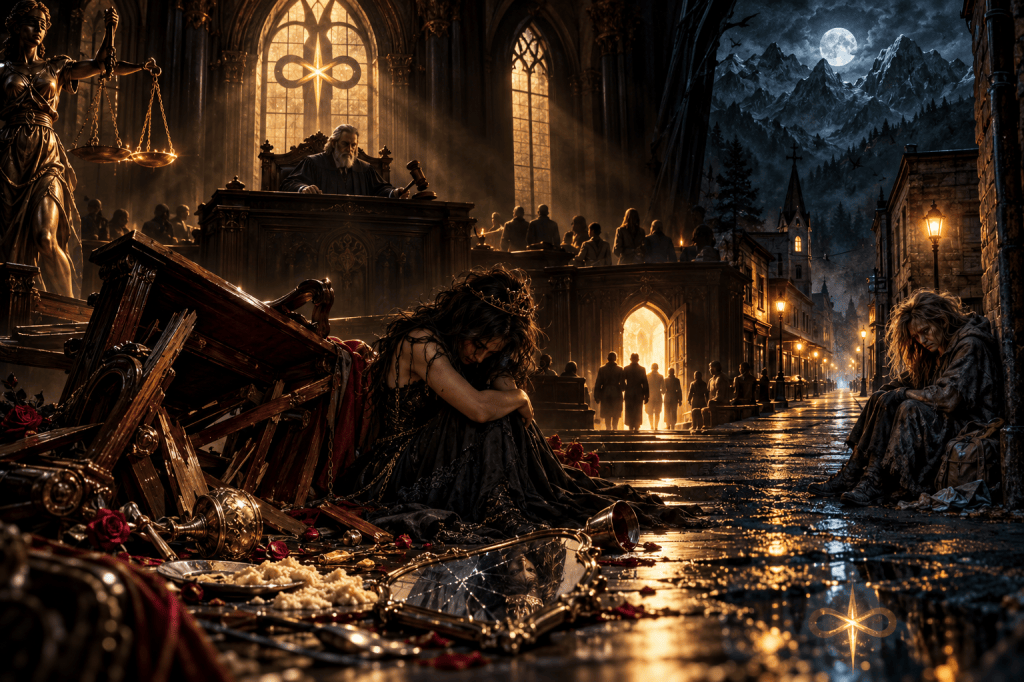
When the tables finally turn you can’t complain about the new seat or the slop you’re forced to eat. Especially when you flipped the table you were sitting at.
Let the court records show, Your Honor, that on the thirteenth day of the tenth month, the evidence was presented in triplicate, bound in black ribbon, and laid upon the mahogany altar of a court that had long since grown weary of hearing the same confession disguised as an accusation.
The defendant remained seated.
Not in remorse, nor in shame, but in the agonishing comfort of a misery so familiar that even freedom had become an unwelcome stranger.
For years, they had wandered the corridors of yesterday, caressing the portraits of things that no longer existed, whispering promises to ghosts that had never promised to return. Every door led to the same chamber. Every chamber held the same mirror. And in every reflection stood the one soul they could neither escape nor accuse without consequence.
The court recommends extensive therapy.
Yet the defendant objects.
Naturally.
Accountability is an intolerable sentence for those who have spent a lifetime appointing others as the architects of their ruin.
And so the prosecution calls its final witness.
Time.
Time enters without ceremony, carrying neither sympathy nor malice. Beneath its robes lie the names of the falsely accused, the innocent souls condemned to carry burdens that were never theirs. Some had spent years beneath the weight of another’s unhappiness, digging through wreckage they had not created, offering bloodied hands to someone determined to remain among the ruins.
Those hands are gone now.
Their former prisoners have walked beyond the iron gates, into mornings the defendant refuses to acknowledge. They have built gardens where nothing grew, found warmth in unfamiliar places, and discovered that an empty room need not remain a tomb.
But inside the courtroom, the defendant still demands an explanation.
Who moved the furniture?
Who extinguished the candles?
Who permitted the world to continue without their consent?
A finger rises toward the heavens, trembling with jealousy and regret. The accusations echo against the vaulted ceiling, though the gallery has long since emptied.
Once, a false god answered every prayer. Every demand was met with an offering, every tantrum rewarded with another sacrifice. But even false gods require worshippers, and the last devoted soul has abandoned the altar.
The chalice stands empty.
No wine. No water. Not a single drop of devotion remains.
The defendant lifts it toward the darkness, waiting for another to fill what they have never learned to replenish themselves.
Nothing comes.
Beyond the courthouse windows, a small mountain town sleeps uneasily beneath the October moon. Its crooked streets wind between ancient buildings, where saints watch from distant heights and the restless seek salvation in shadows.
There, a woman wanders beneath the failing streetlamps, her body ravaged by methamphetamine, her thoughts imprisoned somewhere between the living and the lost. Everyone knows her name. The merchants recognize her footsteps. The townspeople whisper when she passes.
Yet no hand reaches from the darkness.
Perhaps too many hands have reached before.
Perhaps every offered kindness became another stone upon the road to her destruction.
Or perhaps the town has simply learned the terrible distinction between extending a hand and surrendering one’s life to keep another from falling.
Inside the courthouse, the defendant has begun to weep.
Not for the prisoners.
Not for the wreckage.
But for the terrible discovery that the world has ceased arranging itself around their suffering.
The judge rises.
There will be no further testimony. No appeal to yesterday. No resurrection of the dead simply because the living find their absence inconvenient.
The innocent are released.
The sentence is not imprisonment, for the defendant has already fashioned a cell from memory, envy, and an insatiable hunger for what belongs to another.
The sentence is to remain in the company they once declared sufficient.
Themselves.
And as the final candle gutters, a faint scraping rises from beneath the defendant’s chair.
The sound of wood against stone.
For the table they overturned so many years ago has never been righted.
And there, among its splintered legs and scattered silver, lies the feast they demanded.
Cold.
Untouched.
Their own.
Court adjourned.
(Empty-Ray LaMontagne)

