

An Arrival into the Opposite
There are places one travels to, and places one arrives in without ever quite understanding how.
This was the latter.
Beyond the last familiar road, just outside a town that seemed to have misplaced its light, the world began to fold upon itself. Streets wound where streets ought not wind. One-way passages collided with impossible turns, and every road appeared to know a secret it had no intention of surrendering.
The town rose from the mountainside like something that had been buried alive and had slowly clawed its way back into the world.
Nothing stood quite straight.
Houses clung to the earth at unforgiving angles, their foundations swallowed by stone, their upper stories suspended over empty air. Staircases vanished between buildings. Doors opened upon unexpected heights. Treehouses swayed above the ground as though the trees themselves were breathing beneath them.
And everywhere, the undeniable sensation of being observed.
The antique shops were particularly curious.
Behind their darkened windows rested the belongings of strangers long departed. Porcelain faces watched from dusty shelves. Tarnished silver reflected things imperfectly. Clocks stood motionless, though one could almost hear their ticking.
Some doorways offered warmth. Others exhaled a coldness that seemed to have no acquaintance with the weather.
It was not the cold of autumn.
It was older.
The streets filled with wandering congregations of twenty, perhaps thirty souls, following lanterns and listening eagerly for tales of the dead. They came in search of something dreadful, some apparition willing to make itself known for the price of admission.
Yet nothing appeared.
How interesting, I thought, that so many should gather to search for ghosts while never considering what might be walking among them.
A chapel stood concealed among the hills, almost as though the mountain had attempted to keep it for itself. Elsewhere, fountains emerged unexpectedly from the stone, their waters murmuring into basins whose origins seemed as uncertain as the roads.
Even the food possessed a certain eccentricity. A splendid meal, accompanied by potatoes and horseradish, the latter arriving with all the subtlety of a confession extracted under duress.
One could scarcely object.
This was, after all, a place where the ordinary appeared to have been politely dismissed.
As evening descended, the striped pavement guided the living through the crooked streets, while signs appeared at every turn requesting payment for one curiosity or another.
A few dollars for a story.
A few more for a haunting.
Another sum for the privilege of descending into a morgue, where the dead had once rested and where, according to certain accounts, the trouble had begun.
But had it?
There was something almost amusing about the notion that death should require a ticket, or that the departed would honor the boundaries of a guided tour.
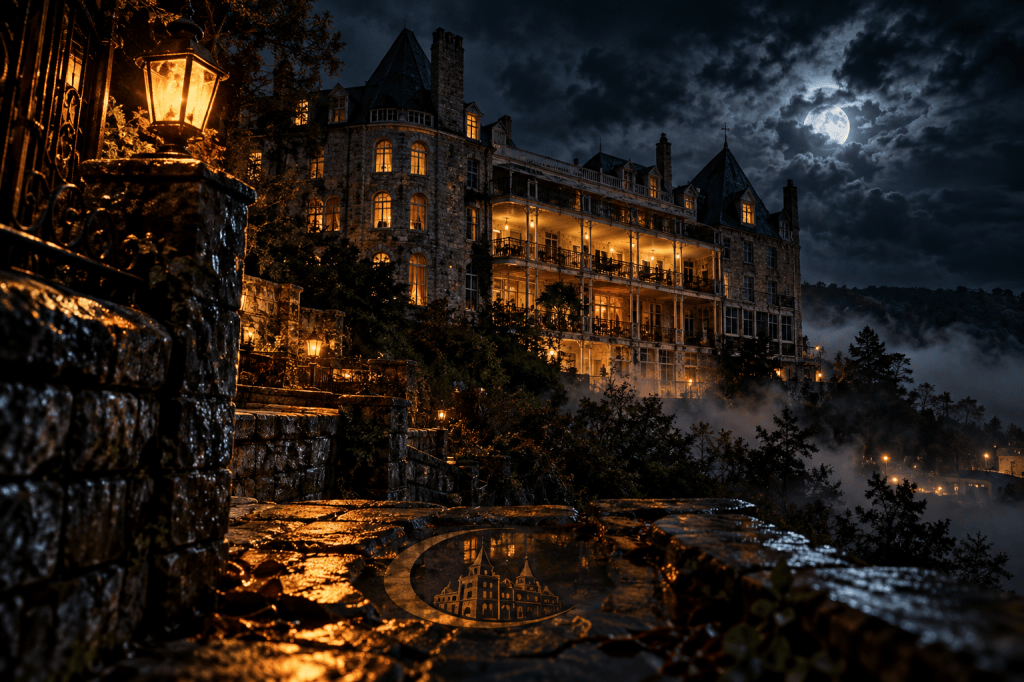
High above the town, behind the walls of an old hotel, another name passed from mouth to mouth.
Michael.
Down the hallway.
Room 219.
His name traveled more freely than any guest, carried upon whispers through corridors where the living hoped desperately to encounter the dead.
And still, I wondered whether Michael was the one being sought, or whether something else had learned to answer to his name.
For there were faces in the streets that seemed strangely absent from themselves. Figures passing beneath the lamps, their expressions lost in shadow, their footsteps swallowed by the crooked pavement.
The nameless wandered beside the named.
The curious beside the indifferent.
And somewhere between the antique windows, the mountain walls, and the restless crowds, the town seemed to rearrange itself whenever no one was looking.
By midnight, I could no longer say with certainty whether the roads had led us into the town or whether the town had quietly drawn its roads around us.
There is a difference.
A most dreadful difference.
Now the second day approaches.
The morning light will undoubtedly restore the illusion of ordinary things. The shops will open. The fountains will continue their endless conversations with the stone. Travelers will wander the crooked passages, convinced that everything worth discovering has been conveniently marked upon a map.
But the mountains have stood here considerably longer than the maps.
And whatever rests beneath them has had ample time to learn the habits of visitors.
Last night, the town offered its stories.
Today, perhaps, it will offer something else.
For I have begun to suspect that the strangest thing about this place is not how many people come searching for the dead.
It is how confidently they assume they are the ones doing the searching.

