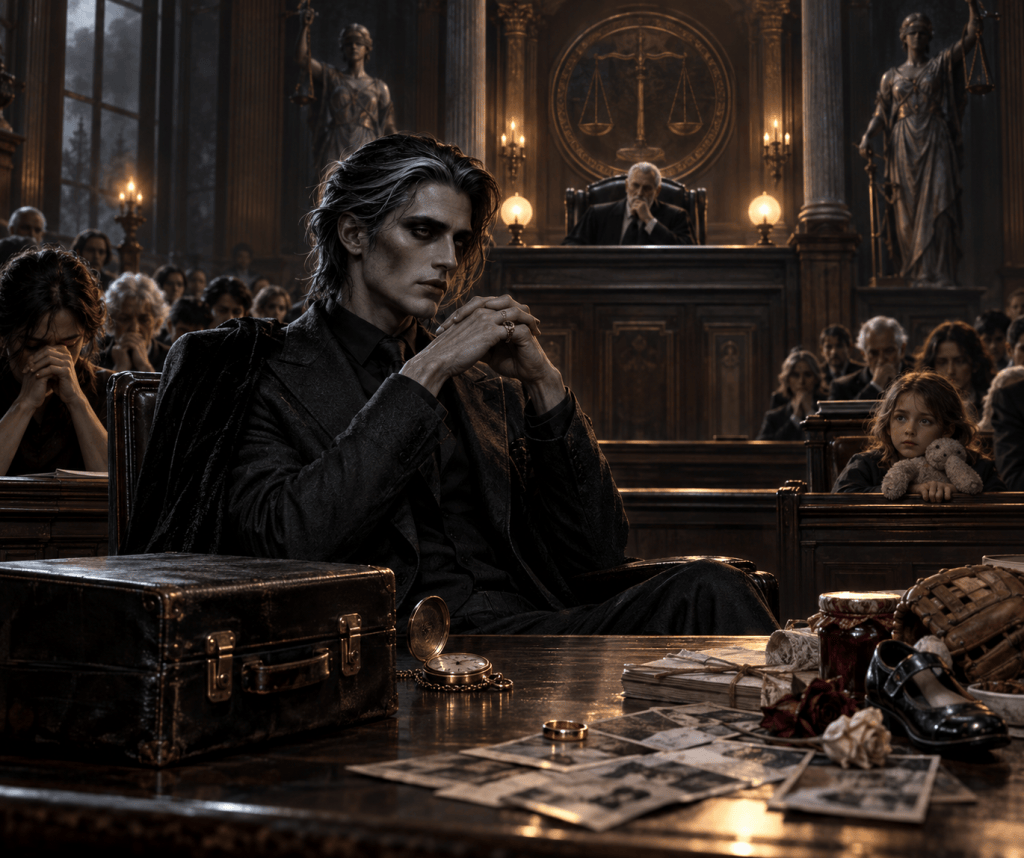
Death arrived eleven minutes late to his own trial.
The courtroom had been full since dawn.
Every pew behind the railing was occupied by someone carrying evidence. A widow held a wedding ring between her thumb and forefinger. A father had brought a baseball glove that had not been used in nine years. An old woman kept a hospital bracelet folded inside a handkerchief. Near the back, a little girl slept against her aunt with one patent-leather shoe missing.
Nobody knew who had called the case.
It had simply appeared on the docket one Monday morning.
THE PEOPLE v. DEATH
No case number.
No filing date.
No attorney of record.
The clerk had tried to remove it twice.
Both times, it returned.
At 9:11, the doors opened.
Death walked in alone.
He was disappointingly ordinary.
No black robe. No scythe. No hollow face beneath a hood.
He wore a charcoal suit with a slight shine at the elbows and carried a leather briefcase that looked older than everyone in the room. His shoes were wet, although it had not rained.
He sat at the defense table.
The judge stared down at him.
“Counsel?”
“I’ll speak for myself.”
His voice caused an elderly man in the third row to begin crying.
Death looked at him.
For half a second, something passed between them.
The man stopped.
The prosecution began with photographs.
There were thousands.
School portraits. Ultrasounds. Military photographs. Christmas mornings. Drivers’ licenses. Blurry photographs taken in bars. Babies asleep on chests. Women standing beside birthday cakes with their eyes closed before the candles went out.
Each photograph was entered into evidence.
Death objected to none of them.
Then came the witnesses.
A woman testified about her husband.
Forty-three years married.
Cancer.
Seven months from diagnosis to funeral.
She described the last morning in unnecessary detail. The untouched coffee on the bedside table. The television playing to an audience of no one. The nurse entering at 6:42 and leaving the door partly open behind her.
She turned toward Death.
“You took him.”
Death folded his hands.
“Yes.”
The courtroom shifted.
The prosecutor waited for more.
Nothing came.
A mother was next.
Her testimony lasted twelve minutes.
Death looked at the table for all twelve.
When she finished, she walked past the prosecution and stopped directly in front of him.
“I hate you.”
“I know.”
She slapped him.
The bailiff moved forward.
Death raised one hand.
“No.”
A red mark appeared slowly across his cheek.
The mother returned to her seat.
Death never touched it.
By afternoon, the evidence table had disappeared beneath the belongings of the dead.
A wristwatch stopped at 3:17.
A recipe written in blue ink.
A pair of reading glasses.
A dog collar.
A voicemail saved on three different phones.
A half-finished crossword puzzle.
One jar of strawberry preserves dated August 14, 1987.
The prosecutor held up each item as though the correct arrangement of ordinary things might finally prove something enormous.
Death watched.
Occasionally, he wrote in a small notebook.
At 4:06, the prosecutor approached him.
“Do you enjoy it?”
Death looked up.
“Enjoy what?”
“This.”
The prosecutor gestured toward the gallery.
Death followed his hand.
Two hundred faces stared back.
“No.”
“Do you feel remorse?”
Death considered the question.
“For doing what I was appointed to do?”
A murmur moved through the room.
“Appointed by whom?”
Death glanced toward the ceiling.
The prosecutor smiled.
“Convenient.”
“Yes,” Death said. “You have always found silence convenient when it belongs to someone else.”
The judge struck the gavel.
“Answer only what you’re asked.”
Death nodded.
The prosecutor returned to his table.
“Have you ever taken the wrong person?”
For the first time all day, Death did not answer immediately.
The room changed.
Even the court reporter stopped typing.
Death opened his briefcase.
Inside were no files.
Only envelopes.
Thousands of them, bundled with string.
Some were yellow with age. Others looked newly sealed.
He selected one.
The prosecutor stepped closer.
“What is that?”
Death turned the envelope over in his hand.
“A name.”
“Whose?”
“I’m not permitted to say.”
“Someone in this room?”
Death looked toward the gallery.
Nobody moved.
“Yes.”
A woman near the aisle reached for her husband.
The prosecutor’s expression hardened.
“So you came here today knowing you would leave with someone?”
“I never enter a room without knowing how I’ll leave it.”
The judge ordered the envelope returned to the briefcase.
Death obeyed.
At 5:32, the prosecution rested.
The judge removed his glasses.
“Call your first witness.”
Death stood.
“I have only one.”
The side door opened.
A court officer entered carrying a cardboard box.
He placed it on the witness stand.
The prosecutor laughed once.
“What is this?”
Death approached the box.
“The defense.”
He removed a white cotton shirt.
A bottle of perfume.
A child’s drawing of three people beneath an enormous purple sun.
A chipped coffee mug.
A paperback with a bent spine.
A set of car keys.
A grocery receipt.
Nothing remarkable.
Then he placed a sealed plastic bag on the rail.
Inside was a woman’s gold bracelet.
The prosecutor stared at it.
His face emptied.
“No.”
Death said nothing.
The prosecutor stepped backward.
“No.”
The judge leaned forward.
“Counsel?”
The prosecutor was no longer looking at the bench.
He was looking at the bracelet.
“My sister wore that.”
Death returned to his chair.
The prosecutor picked up the evidence bag with both hands.
“She was twenty-six.”
“Yes.”
“She was driving home.”
“Yes.”
“She had just called me.”
“Yes.”
“I told her I was busy.”
Death lowered his eyes.
The prosecutor’s fingers tightened around the plastic.
For the first time that day, nobody looked at Death.
They looked at the prosecutor.
At the bracelet.
At the small, stupid, unbearable distance between I’m busy and a telephone that would never ring from that number again.
The prosecutor sat down.
The judge waited.
Outside, evening pressed itself against the tall courthouse windows.
“Does the defense have anything further?”
Death stood.
“No, Your Honor.”
“No argument?”
“No.”
“You understand the possible judgment against you?”
“I do.”
The judge studied him.
“And you have nothing to say in your defense?”
Death looked around the courtroom.
At the photographs.
The baseball glove.
The hospital bracelet.
The jar of preserves.
The little girl, now awake, still missing one shoe.
Then he reached inside his coat and removed a pocket watch.
He opened it.
Tick.
Tick.
Tick.
Every clock in the courtroom stopped.
Death closed the watch.
The clocks resumed.
5:47.
He placed the watch on the defense table.
“No,” he said. “But I believe the prosecution has mistaken me for the crime.”
Nobody wrote that down.
The jury deliberated for three days.
On the fourth morning, the courtroom filled again.
Death wore the same charcoal suit.
The red mark on his cheek was gone.
The foreman stood.
The clerk asked whether they had reached a verdict.
“We have.”
The paper trembled in his hands.
“On the charge brought by the living against Death, we find the defendant…”
He stopped.
His mouth moved.
Nothing came out.
The judge frowned.
“Read the verdict.”
The foreman stared at the page.
“It’s blank.”
The clerk took it from him.
Then the judge.
Blank.
A bailiff checked the original verdict form.
Blank.
Someone in the gallery began to laugh.
Someone else began to pray.
Death looked at the clock.
9:11.
The little girl from the first day slipped beneath the railing before her aunt could catch her.
She walked directly to the defense table.
Death crouched so they were eye level.
She whispered something into his ear.
Nobody heard it.
He smiled.
Not kindly.
Not cruelly.
Just as though she had remembered the answer to a question everyone else had forgotten.
She handed him her missing shoe.
Death placed it inside his briefcase.
Then he left the courtroom alone.
Hours later, while the clerk was clearing the evidence table, she noticed something written on the underside of the judge’s bench.
The wood had been polished every evening for seventy-three years.
She had never seen the inscription before.
Neither had the judge.
Neither had anyone.
There were no fingerprints around it.
No scratches from a knife.
Just nine letters pressed deep into the mahogany, dark with age.
The clerk counted them twice.
Then she locked the courtroom without telling anyone what they spelled.


Leave a comment