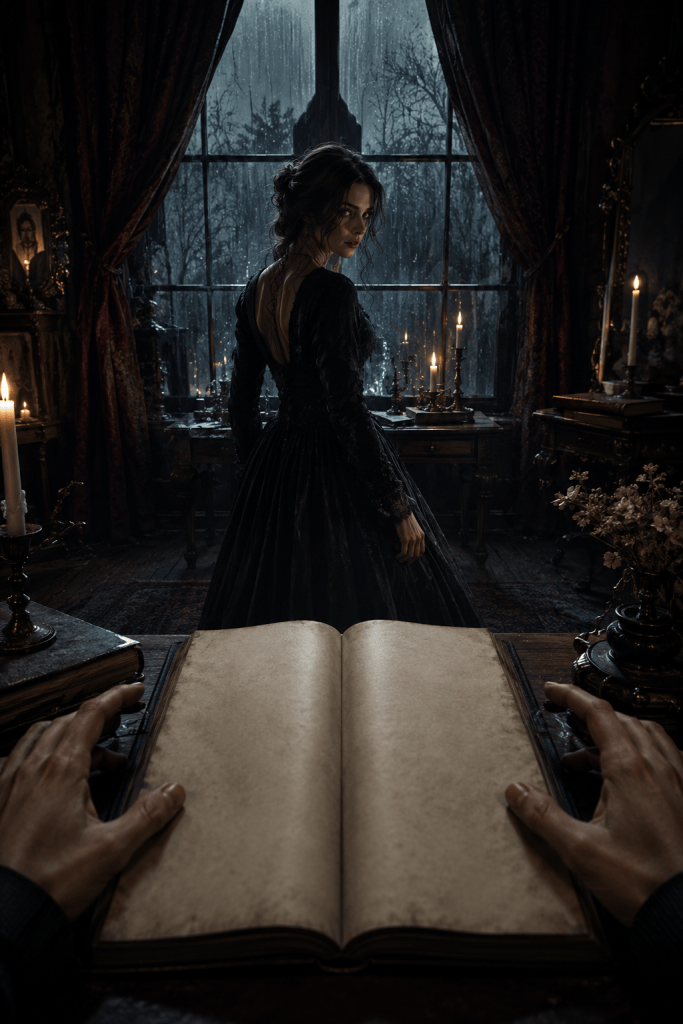
When the character looks directly at the reader is a strange moment.
Not toward them.
Not past them.
At them.
For a long time, the writer had pretended not to notice.
The writer knew when the pages were being turned. They could feel the slight disturbance in the air every time someone arrived looking for another chapter. Some came quietly. Some returned religiously. Others swore they had stopped reading while somehow knowing exactly what happened three paragraphs ago.
The writer never questioned it.
Every story needs a reader.
At least, that is what writers tell themselves.
So the writer continued living where everyone could see.
They walked through rooms with enormous windows and never bothered closing the curtains. They left sentences unfinished on tables. They abandoned thoughts in hallways. They spoke too loudly in places where whispers traveled better than screams.
There were fingerprints everywhere.
Not theirs.
People had been pressing their faces against the glass for years, trying to understand what was happening inside.
The funny thing about dirty windows is that eventually the person looking through them forgets the dirt is on their side.
They see shadows and call them monsters.
They see someone leave and call it abandonment.
They see someone stay and call it weakness.
They watch a person burn their old life to the ground and spend hours discussing the fire without ever asking what needed to die.
Everyone loves an explanation.
Especially when it belongs to somebody else.
The writer had spent years giving them one.
Perhaps that was the mistake.
Every time someone misunderstood a chapter, the writer wrote another.
Every time someone questioned the plot, the writerr explained the character.
Every time someone decided they knew the ending, the writer tried to prove there were still pages left.
Eventually, the book became less about living and more about explaining why the writer was alive.
That is a terrible way to write a story.
So one evening, somewhere between the chapter everyone thought they understood and the chapter nobody knew was coming, she stopped.
The room was unusually quiet.
A candle burned beside the writer.
Rain crawled slowly down the windows, taking old fingerprints with it.
The book rested open on the desk.
There were words on the page, but the writer wasn’t reading them.
The writer was listening.
There it was.
That familiar sound.
A page turning.
The writer smiled.
Someone was still there.
Of course they were.
They always were.
The writer stood from the desk and walked across the room. Their footsteps were slow enough that whoever was watching could count them.
One.
Two.
Three.
They stopped.
Then the writer did something characters aren’t supposed to do.
The writer looked directly out of the story.
At you.
There was no anger on their face.
That would have been easier.
Anger gives the audience something to discuss.
There was no sadness either.
Sadness would have allowed someone to believe the writer was wounded.
There was only recognition.
I know you’re there.
The writer didn’t say it.
They didn’t have to.
For the first time, the reader became uncomfortable.
Because readers are supposed to observe.
They are supposed to sit safely outside the consequences and decide which characters were good, which were terrible, which should have stayed, which should have left, and which mistakes could have been avoided if everyone had simply listened to them.
Readers have the luxury of hindsight.
Characters have to survive the scene.
That is the part nobody remembers.
The person inside the chapter doesn’t know what happens on the next page.
They don’t know the stranger becomes important.
They don’t know the friend becomes a stranger.
They don’t know which goodbye is permanent.
They don’t know the ordinary day they complained about will someday become a day they would give anything to live again.
They only know now.
And now is a dangerous place to make permanent decisions.
The writer understood that finally.
Maybe that was why they had stopped explaining themselves.
There was nothing left to explain.
Some people would always believe the version they created while looking through their own window.
Let them.
Some would continue reading because they were waiting for the writer to fail.
Let them wait.
Some would search every sentence for themselves, convinced that surely every villain wore their face.
Let them wonder.
And some would understand completely.
Those were never the people the writer was writing explanations for anyway.
The writer returned to the desk.
The candle had nearly burned itself out.
The writer picked up the pen.
The reader leaned closer.
Finally.
Another chapter.
But they didn’t write.
Instead, she reached toward the edge of the page.
Something strange happened then.
The walls began disappearing.
The room.
The windows.
The rain.
The desk.
Even the candle surrendered its final flame.
The reader turned the page.
Blank.
Another.
Blank.
Faster now.
Blank.
Blank.
Blank.
There had to be more.
There was always more.
They flipped backward looking for something they had missed.
A clue.
A warning.
A sentence hidden inside another sentence that would explain where they had gone.
Nothing.
For the first time, the reader had no idea what happened next.
And somewhere beyond the pages, beyond the windows, beyond the walls built between observation and living, they walked into a life nobody had been given permission to read yet.
Maybe the writer fell in love.
Maybe the writer left.
Maybe the writer stayed.
Maybe the writer built something beautiful.
Maybe the writer burned something beautiful down.
Maybe the writer finally did the thing everyone said they couldn’t do.
Maybe nothing dramatic happened at all.
Maybe the writer simply woke up one morning, drank their coffee slowly, laughed with the people they loved, and realized ordinary happiness had been the treasure everyone kept walking past while searching for the plot twist.
The reader would never know.
Not everything that happens needs an audience.
Not every decision requires a witness.
Not every life needs commentary from the people standing outside of it.
And not everyone who has read your story has earned the right to know how it ends.
The last page contained only one sentence.
The reader stared at it for a long time.
Then the book quietly closed itself.
You were never watching her story. The writer was watching what you did with it.


Leave a comment