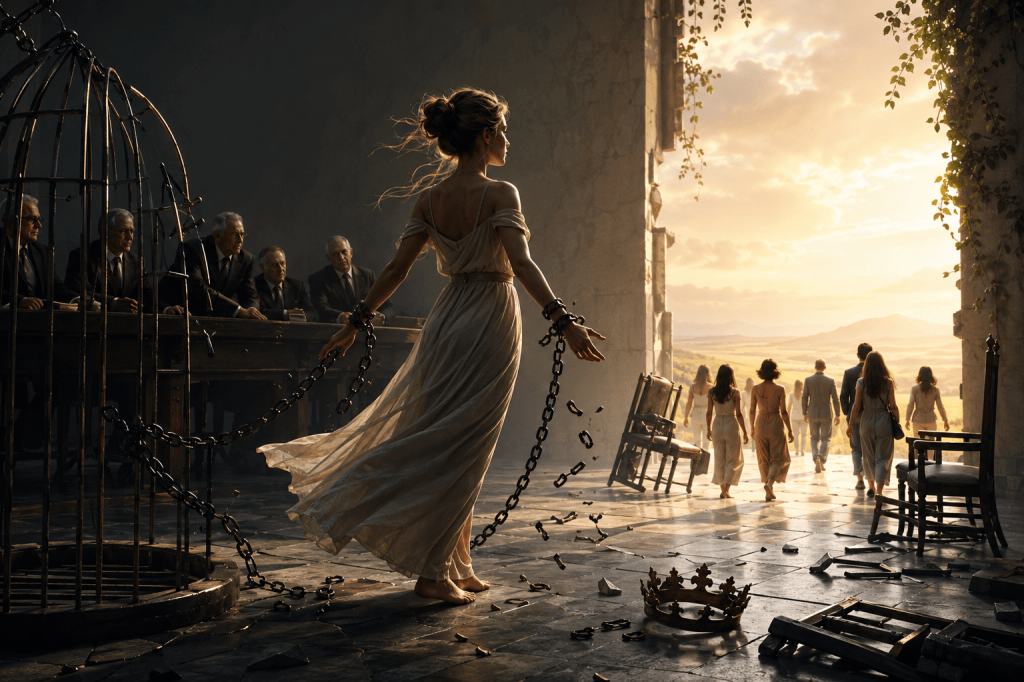
There is a room hidden beneath history that few people have ever been invited to see.
It has no king upon its throne.
Only a contract.
The paper is so old the ink has faded, but every generation signs it without reading it first. They inherit the rules before they inherit their own names.
A little girl walks into the room.
She is carrying nothing.
No title.
No wealth.
No permission.
Only possibility.
The old men seated around the table smile politely.
“We already have a place for you,” they say.
They slide a chair across the floor before she even has the chance to choose where she wants to sit.
“This is where you’ll belong.”
She looks around the room.
Every chair has already been assigned.
One for the provider.
One for the protector.
One for the nurturer.
One for the obedient.
One for the leader.
One for the follower.
No one asks whether the chairs were ever built correctly.
Only whether everyone remains seated.
Years pass.
The girl grows into a woman.
She watches her own body accomplish things that no throne in the room could ever imitate.
It stitches wounds without asking.
It grows stronger after breaking.
It creates bone from nothing.
It creates organs from invisible instructions.
It creates blood.
It creates milk.
It carries another heartbeat while keeping its own alive.
It survives pain that language still struggles to describe.
She begins to wonder why anyone would call something so extraordinary naturally submissive.
Creators do not exist because permission was granted.
Creation happens because life insists.
History has often mistaken endurance for obedience.
They are not the same thing.
The woman studies the contract lying on the table.
Something feels strange.
She notices that the agreement was never written between equals.
Many of the signatures belong only to the people who benefited from writing it.
The rules begin to reveal themselves.
“You cannot own property.”
“You cannot vote.”
“You cannot attend.”
“You cannot study.”
“You cannot earn.”
“You cannot decide.”
“You cannot leave.”
Then another sentence appears underneath every restriction.
“Fortunately, someone else will provide.”
She laughs.
Not because it is funny.
Because suddenly she understands the trick.
If someone locks every grocery store in town except one, they can stand outside the only open door calling themselves generous.
If someone breaks another person’s legs, carrying them afterward is not proof of kindness.
If someone removes every opportunity and then offers survival as a favor, that is not generosity.
It is dependence by design.
History has never been as simple as heroes and villains.
Many men loved their families deeply.
Many women found purpose inside traditional roles because they freely chose them.
Choice is beautiful.
The absence of choice is something entirely different.
That is where the story changes.
There is nothing wrong with providing.
There is everything wrong with making sure no one else is allowed to.
Those are two different things that often wore the same uniform.
The room begins to shake.
Not because anyone started fighting.
Because people started asking questions.
Who built these chairs?
Who decided these jobs?
Who benefited from these arrangements?
Who was praised for carrying burdens they assigned themselves?
The old contract begins to crumble into dust.
Not because someone burned it.
Because truth has a habit of aging better than control.
The woman stands.
She does not stand above anyone.
She simply refuses to remain where someone else placed her centuries before she was born.
Across the room, others begin standing too.
Some are women.
Some are men.
Because freedom was never supposed to belong to one side.
It belongs to everyone willing to choose instead of inherit.
A young man quietly tears up his own assigned chair.
He admits he never wanted to carry expectations that told him his worth depended only on what he earned.
Across from him, a woman walks away from the chair that insisted her value existed only in serving someone else’s purpose.
Neither one leaves weaker.
Both leave lighter.
The room grows quieter than it has been in centuries.
Without assigned seats, people finally have to introduce themselves.
Not by role.
Not by obligation.
Not by tradition.
By character.
Maybe that was always the point.
The strongest relationships have never been built on forced hierarchy.
They are built on mutual respect.
On chosen sacrifice.
On shared responsibility.
On admiration instead of obligation.
Power that must restrict another person to survive was never power.
It was fear wearing expensive clothes.
Freedom has a peculiar habit.
It never asks anyone to become less.
It simply allows each person to become fully themselves.
Perhaps that is why the old throne now sits empty.
Not because nobody wanted authority.
Because people finally discovered that love has never needed a ruler.
Only willing participants.
And the contract that once called itself protection was quietly revealed for what it had always been.
Not a gift.
Just permission disguised as generosity.
The day people stopped confusing the two was the day the throne lost its kingdom.


Leave a comment