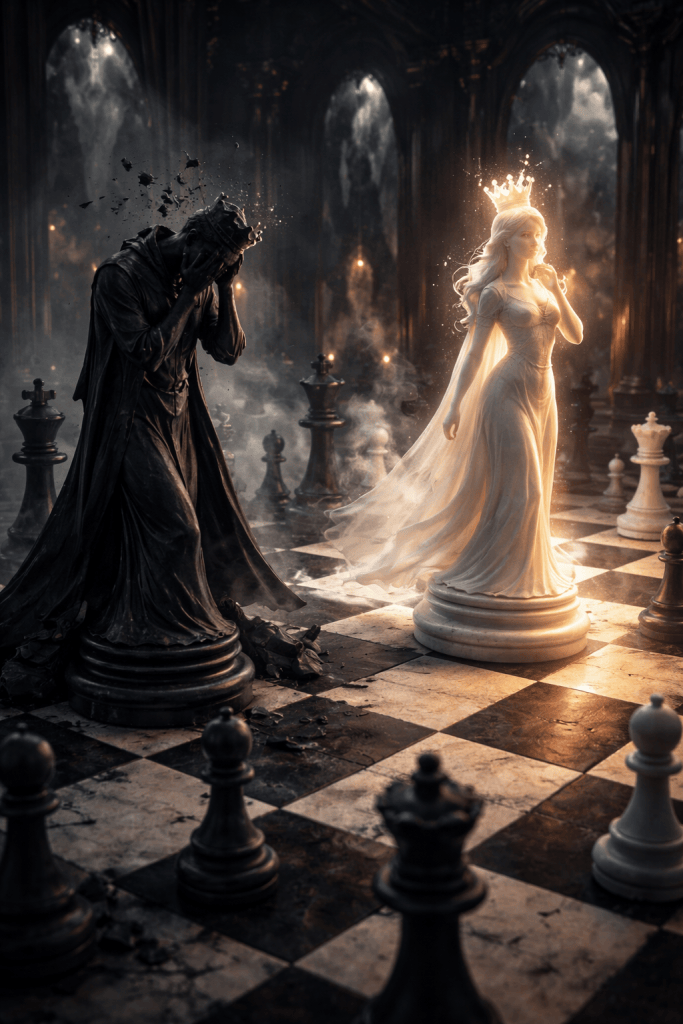
The board is already set when you arrive.
You just don’t remember agreeing to play.
Black squares. White squares. Mirrors where bishops should be. Reflections where pawns swear they’re kings. Somewhere between the ranks, a voice says it’s stuck. Another insists the game is rigged.
One piece moves.
One piece explains why it won’t.
The one who won’t move asks for a hand. Says no one ever taught them the rules. Says the board is unfair, the opponent invisible, the clock broken. They lean on the square they started on and call that strategy.
The board disagrees.
The board shows that every square forward costs something.
The board shows that staying still feels safe until it becomes permanent.
The board shows exits disguised as risk.
The other piece is harder to find.
Not missing. Just positioned where complaint can’t reach. It slips diagonally when expected to go straight. It sacrifices pieces no one else would give up. It hides behind silence, not fear.
If you listen closely, the board whispers clues.
Why does the trapped piece keep talking instead of moving?
Why does it demand rescue while guarding its square so fiercely?
Why does it call the moving piece selfish for not stopping?
Because stillness wants company.
Because explanation is cheaper than action.
Because it’s easier to narrate the loss than to risk a move that might fail.
The moving piece knows something the other refuses to see: no one is coming across the board to lift it. No rule allows it. No hand reaches in from outside the game.
The only thing that changes position is choice.
So the moving piece keeps shifting. One square at a time. Sometimes backward to go forward later. Sometimes disappearing entirely, not because it’s lost, but because it refuses to be captured by a square that never intended to advance.
The trapped piece shouts “checkmate” every time it feels uncomfortable.
The board remains silent.
Riddle me this:
If the board shows you paths you refuse to take, who is keeping you there?
If another piece can move freely, what rule are you honoring that they are not?
If misery needs an audience, why does it call solitude cruelty?
White still moves first.
But the game only ends
when one piece stops mistaking stillness for safety
and finally steps off the square it keeps defending like a throne.


Leave a comment