
Eventually children grow up to make up their own minds. Make sure what you are feeding them can’t be backed up with receipts.
Once upon a most unfortunate time, beyond the crooked woods and beneath a sky painted in shades of violet and gold, there existed a marvelous little kingdom called Candyland.
Oh, what a splendid place it was.
Rivers of chocolate wound through emerald meadows. Sugar-spun roses climbed the walls of gingerbread cottages. Crystal fountains poured sweet nectar into pools of shimmering silver, while delicate butterflies carried the fragrance of honey and wildflowers through the warm afternoon air.
It was a kingdom born of innocence, where laughter lived in every corner and possibility stretched beyond the horizon.
But paradise, as it so often happens, had acquired a rather dreadful guardian.
A giant.
Not the magnificent sort one might find in the pages of a beloved fairy tale. No, this creature was a grotesque assembly of bitterness, swollen pride, and an appetite that could never be satisfied.
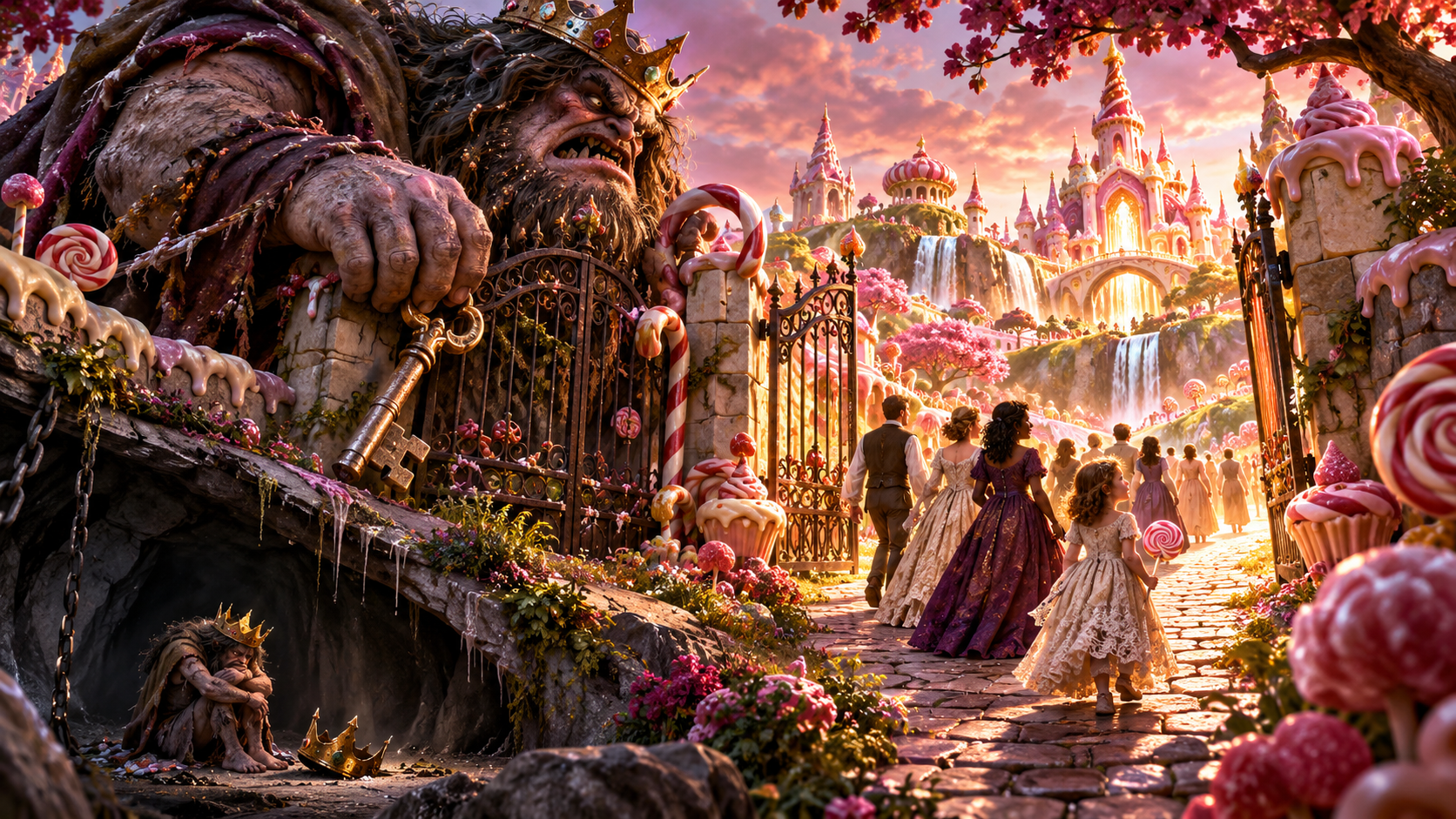
Its enormous body cast a shadow across the kingdom gates. Its crooked fingers clutched a great iron key, and upon its hideous head sat a crown fashioned from the broken promises of those who had once believed it.
The giant had appointed itself the keeper of Candyland.
Not because it had created the kingdom.
Not because it had nurtured its beauty.
But because it had discovered that standing between something precious and those who loved it was a marvelous way to feel important.
And oh, how the beast adored importance.
Visitors approached the gates bearing kindness, affection, and gifts. Some came with open hearts. Others carried memories of laughter, celebrations, and promises of adventures yet to come.
But entrance was never granted freely.
The giant demanded tribute.
A compliment here. A favor there. A declaration of loyalty whispered beneath the enormous shadow of its throne.
Those who pleased the beast were welcomed with theatrical generosity.
Those who questioned its authority were turned away.
And those who dared to challenge its version of events discovered that yesterday’s invitation had mysteriously become today’s unforgivable offense.
How terribly convenient.
For the giant possessed a remarkable talent for rearranging history.
A kindness became an insult.
A promise became a threat.
A perfectly ordinary conversation became evidence of some terrible conspiracy.
And whenever anyone questioned these extraordinary transformations, the beast would stamp its enormous feet and roar until the very gumdrop trees trembled.
“I AM THE GUARDIAN! I KNOW WHAT IS BEST!”
The echoes traveled across the kingdom.
But echoes, dear reader, are merely noise returning to its source.
They have never been proof of truth.
Years passed.
Candyland began to change.
Its little pathways grew wider. Its trees stretched toward the heavens. The tiny houses expanded into magnificent halls, and the once-innocent kingdom began developing something the giant had never anticipated.
A mind of its own.
Questions appeared like wildflowers between the cobblestones.
Why were some visitors welcomed one day and forbidden the next?
Why did the rules change whenever the giant’s mood soured?
Why were acts of love described as wickedness, while acts of cruelty were dressed in the finest robes of righteousness?
And perhaps most troubling of all…
Why did the giant become so terribly frightened whenever someone remembered what had actually happened?
The beast attempted to answer these questions with more stories.
Marvelous stories.
Terrible stories.
Stories so elaborate that even the giant occasionally forgot which version it had told the day before.
It scattered accusations like poisoned sugar across the kingdom, hoping the sweetness of familiarity would disguise the bitterness beneath.
But Candyland was growing older.
And age, when accompanied by wisdom, possesses the extraordinary ability to distinguish nourishment from poison.
The kingdom began keeping its own memories.
Every invitation.
Every rejection.
Every broken promise.
Every contradiction.
Small truths, carefully preserved, became a library no roaring beast could burn.
The giant, however, remained blissfully unaware of its approaching irrelevance.
It continued to demand admiration.
It continued to insist upon obedience.
It continued to believe that possession of the gate meant ownership of everything beyond it.
Until one particularly beautiful morning, something dreadful happened.
Nobody came.
Not a single visitor stood beneath the iron archway.
No gifts waited upon the stone steps.
No pleading voices begged for permission.
No one sought an audience with the magnificent, all-knowing guardian of sugar and dreams.
The giant waited.
And waited.
By afternoon, it had invented several reasons for the silence.
By evening, it had declared the absence of visitors a glorious victory.
By midnight, it was peering through the bars, desperate for someone to notice its triumph.
But the road remained empty.
You see, the visitors had discovered something rather extraordinary.
There were other ways to love a kingdom.
And there was no reason to continue bargaining with a monster for permission to offer that love.
Without an audience, the giant’s power began to decay.
At first, it was scarcely noticeable.
Its crown slipped sideways.
Its enormous boots grew loose.
Its mighty roar became a hoarse and rather embarrassing squeal.
Then its shoulders began to shrink.
Its fingers, once capable of gripping the great iron gates, curled into trembling little claws.
The more desperately it demanded worship, the smaller it became.
The more outrageous its stories, the weaker its voice.
The more fiercely it clung to control, the less there remained to control.
What a delicious little paradox.
The giant had spent a lifetime making others feel small, never imagining that its own greatness existed only in the space they had allowed it to occupy.
Meanwhile, Candyland had blossomed into something magnificent.
The chocolate rivers deepened into sparkling waterways. The gingerbread cottages became elegant estates. The gardens overflowed with roses no longer trimmed to satisfy the guardian’s peculiar preferences.
And somewhere between childhood and wisdom, Candyland ceased to be Candyland at all.
It became Paradise.
Not because its inhabitants had forgotten their beginnings.
Not because every sorrow had vanished.
But because they had finally understood that love was not a privilege to be distributed by an angry creature standing at a gate.
Love was the very foundation upon which their kingdom had been built.
One golden morning, the gates opened.
Not with a thunderous crash.
Not with the permission of the beast.
But with the gentle turning of a key held by Paradise itself.
Those who had waited patiently beyond the walls were welcomed.
Old friendships found new beginnings.
Laughter returned to places where silence had lingered.
And the kingdom discovered that its beauty had never depended upon the approval of its guardian.
The giant, now scarcely taller than a thistle, stood beneath the enormous archway in absolute disbelief.
It shrieked.
It threatened.
It recited every grievance it had collected over the years.
It demanded that Paradise remember who had been in charge.
But Paradise merely looked upon the miserable little creature with the calm recognition that comes from finally understanding a very old deception.
The giant had never been the protector.
It had been the obstacle.
And obstacles, once recognized, have a curious tendency to lose their importance.
Beneath the kingdom lay an ancient underground passage, dark and cold, where forgotten things were carried away by the turning of time.
There, the tiny beast was cast out.
Its crown shattered upon the stones.
Its iron key fell uselessly into the darkness.
And its last furious demands disappeared into the earth, unanswered.
Far above, Paradise continued to flourish.
Seasons changed.
Children grew.
Memories became stories, and stories became lessons passed gently from one generation to the next.
No one needed to destroy the giant’s reputation.
No one needed to chase it into the darkness.
No one even needed to speak its name.
The truth had simply outlived the lie.
And deep beneath the beautiful kingdom, the creature remained, small and bitter, whispering its version of history to an audience of stones.
Perhaps that was the cruelest punishment of all.
Not exile.
Not loneliness.
Not even the loss of its imaginary throne.
But the discovery that the kingdom it had tried so desperately to possess had grown into something beautiful without it.
For there is a rather magnificent justice woven into the fabric of existence.
Those who nurture love become part of its legacy.
Those who attempt to imprison it become little more than a warning.
And those who feed children stories seasoned with bitterness should remember one final, inconvenient truth.
Children eventually grow old enough to read the receipts.
And Paradise, darling, has a very long memory.