
We light the actual pathetic people on fire and go on with our absolutely ordinary beautiful day.
Not with matches, darling. That would be far too ordinary. We set fire to their illusions, their borrowed convictions, and the magnificent little prisons they have spent their entire existence decorating.
And then we leave them standing among the ashes, wondering why we never bothered to look back.
There is something profoundly tragic about a world that has fallen so deeply in love with its own deception that truth has become its greatest enemy.
Imagine an entire civilization sleeping beneath a velvet sky, its inhabitants moving through the motions of existence with the mechanical precision of an antique clock. Their eyes are open, their hearts continue beating, and their mouths produce an endless procession of words.
Yet something essential remains terribly still.
Their minds.
Ninety percent of humanity, according to our dark little allegory, wanders through existence in a state of magnificent unconsciousness.
They awaken to the same instructions, consume the same manufactured desires, repeat the same inherited opinions, and retire each evening believing they have exercised the extraordinary privilege of free will.
How deliciously ironic.
They call their routines freedom.
Their conditioning, intelligence.
Their obedience, virtue.
And their chains?
Oh, those they polish until they shine.
But no kingdom of illusion survives without its monarchy.
High above this slumbering congregation, beyond the reach of ordinary sight, sits the mythical one percent.
The puppet masters.
They do not require iron shackles or prison walls. Such instruments belong to a less sophisticated century. Their kingdom is constructed from perception, their currency is attention, and their most obedient servant is fear.
Why command a person when you can persuade them that obedience was their own idea?
Why forbid a question when you can make the question itself an object of ridicule?
And why destroy a truth when you can bury it beneath a thousand competing stories until nobody remembers what they were searching for?
But even the most beautiful deception develops fractures.
Somewhere among the sleeping multitude, a small number begin to stir.
Five percent.
The questioners.
The observers.
The souls who notice that something about the magnificent performance does not quite resemble the truth.
They hear the discord beneath the orchestra. They recognize the painted horizon. They begin to suspect that the doors they have been taught to fear might lead somewhere extraordinary.
And so they commit the most unforgivable act imaginable.
They begin asking questions.
Worse still, they invite others to do the same.
Ah, but every kingdom has its guardians.
Enter the remaining four percent.
The gatekeepers.
The trolls.
The self-appointed custodians of acceptable thought.
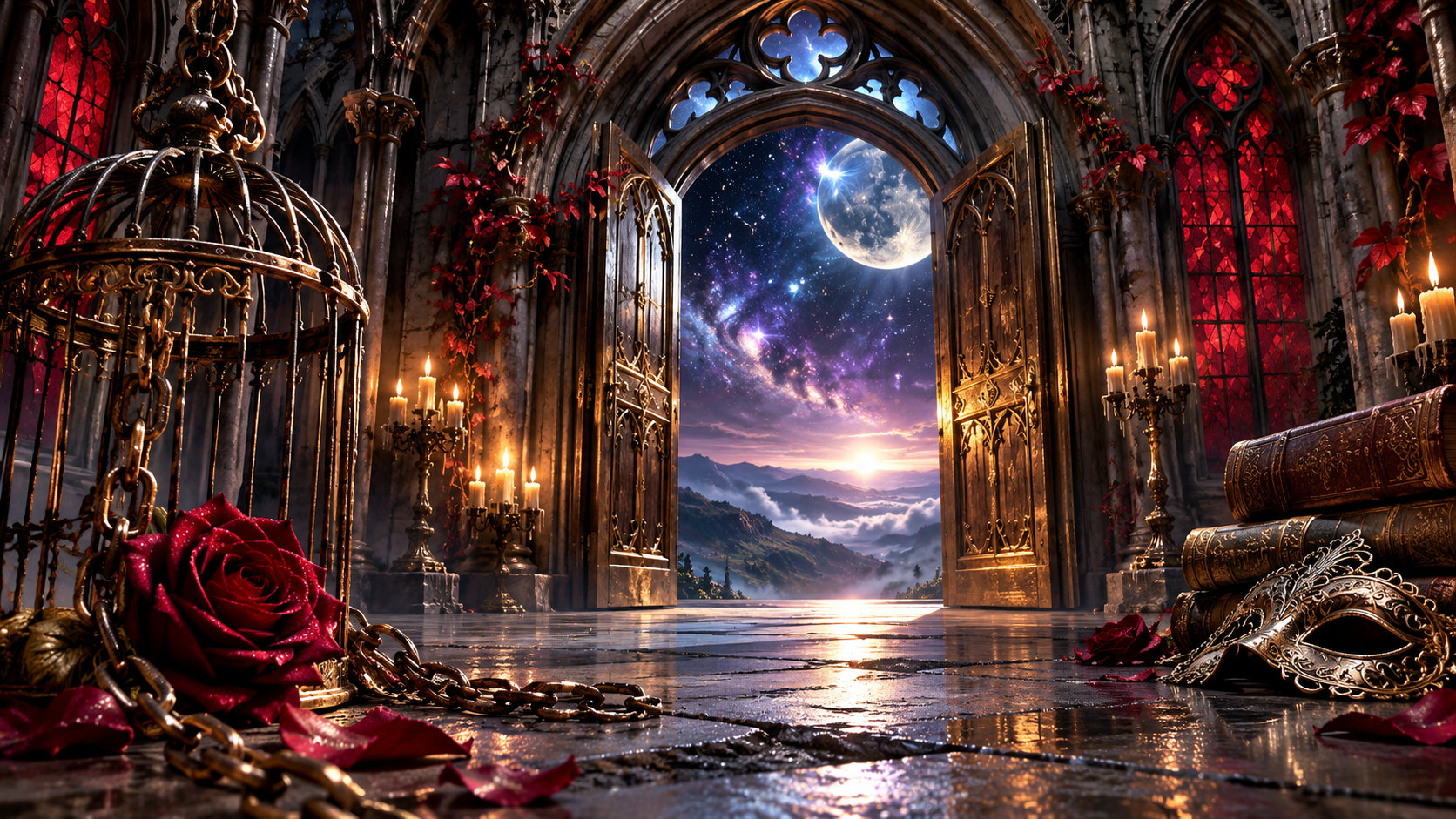
In our imaginary cathedral of deception, they arrive dressed in the respectable garments of authority, carrying their little books of approved conclusions and wearing expressions of extraordinary moral importance.
Some mock.
Some attack.
Some silence through the sheer exhaustion of endless argument.
Others manipulate the invisible machinery of algorithms, ensuring that certain voices rise while others disappear into digital obscurity.
And the most accomplished among them have mastered a particularly elegant cruelty.
They convince the prisoners to defend the prison.
What a remarkable achievement.
The sleepers become the fiercest guardians of their own captivity.
They ridicule the person holding the key.
They curse the hand reaching toward the lock.
They fight with astonishing passion to preserve the very limitations that keep their lives small.
And the architects need only watch.
For this is not a war fought upon blood-soaked battlefields.
It is a war of ideas.
Of attention.
Of perception.
Of fear.
Its weapons are repetition, humiliation, distraction, and the quiet suggestion that independent thought is somehow an act of betrayal.
But the most fascinating prison is not constructed by another human being.
It is constructed within the mind itself.
And here, darling, our story descends into stranger territory.
Beyond the cathedral, beyond the algorithms and manufactured certainties, lies a question so extraordinary that philosophers, mystics, and scientists have approached it from entirely different directions.
What is reality?
Is it merely the world we encounter?
Or does the mind participate in creating the world we experience?
Quantum physics tells us that particles can exist in superpositions of possible states before measurement produces a definite outcome. The observer effect has inspired generations of philosophical speculation, although science has not established that human consciousness alone selects physical reality.
But poetry is permitted to wander where proof has not yet arrived.
And what a magnificent place to wander.
Imagine consciousness as an ancient instrument, its strings vibrating with every thought, every expectation, every deeply held conviction.
Imagine fear as a low, mournful note, repeated so faithfully that its musician forgets another melody was ever possible.
Imagine resentment as a dark symphony that grows louder each time its composer returns to the same familiar suffering.
And imagine, for one exquisite moment, that a person discovers they can change the music.
Not by commanding particles or bending the universe to their will.
But by refusing to surrender their attention to the same destructive patterns.
They begin to choose differently.
Their thoughts become more deliberate.
Their decisions become more courageous.
Their perception widens.
And suddenly, the world they once believed was fixed begins to reveal possibilities they had never allowed themselves to consider.
Coincidences seem to multiply.
Unexpected doors appear.
People arrive at extraordinary moments.
The mystic calls these synchronicities.
The psychologist might speak of attention, expectation, and pattern recognition.
And the poet?
The poet smiles and calls it a conversation with eternity.
Perhaps the frequency of consciousness is not a supernatural command whispered into the machinery of creation.
Perhaps it is the intimate rhythm of everything we repeatedly think, believe, choose, and become.
For a mind imprisoned by fear will overlook opportunities that a courageous mind might recognize.
A soul consumed by bitterness will discover evidence of betrayal in every passing shadow.
And a person who has made obsession their closest companion will eventually mistake its voice for the voice of truth.
Such a dreadful romance.
To spend an entire lifetime devoted to the very thoughts that make existence unbearable.
Yet there is another possibility.
A person may withdraw their attention.
They may cease feeding the machinery of resentment.
They may refuse to participate in battles that offer no victory beyond the temporary satisfaction of being noticed.
And in that beautiful withdrawal, something changes.
Not necessarily the universe.
Something far more immediate.
The person experiencing it.
They become the author rather than the captive of their own narrative.
Their world expands because their choices expand.
Their possibilities multiply because they are no longer searching exclusively for evidence of their limitations.
And the old prison begins to crumble.
Stone by stone.
Belief by belief.
Fear by fear.
Oh, how the gatekeepers would despise such a creature.
Not because they possess some mystical superiority.
Not because they alone have discovered every hidden truth.
But because they have become extraordinarily difficult to manipulate.
They no longer require an audience to validate their existence.
They do not confuse popularity with wisdom.
They do not mistake disagreement for persecution.
And they understand that a genuinely awakened mind must remain capable of questioning even its most cherished conclusions.
For certainty, darling, can become the loveliest prison of all.
There is a terrible beauty in that realization.
The world may be filled with illusions, but not every shadow conceals a puppet master. Not every disagreement is an attack. Not every coincidence is a message from the heavens.
Sometimes a shadow is simply a shadow.
And sometimes the greatest act of rebellion is learning to distinguish what is real from what we desperately wish to believe.
So let the sleepers dream.
Let the gatekeepers guard their imaginary thrones.
Let the architects construct their elaborate palaces of smoke and mirrors.
And let the questioners continue asking questions, even of themselves.
For somewhere beyond the noise, beyond the manufactured outrage and endless performance of human importance, there exists a quieter kind of freedom.
One that does not demand obedience.
One that cannot be purchased with approval.
One that begins the moment a person recognizes that their attention is among the most valuable possessions they will ever own.
Guard it carefully.
Give it to beauty.
Give it to knowledge.
Give it to love, creation, and the extraordinary mystery of being alive.
But never surrender it to someone who requires your suffering to feel significant.
And should some miserable little creature arrive at your doorstep demanding that you return to the cathedral and defend the chains you have already discarded?
Smile, darling.
Strike a match against the last illusion you ever needed.
Watch its ashes disappear into the evening wind.
Then turn toward the magnificent uncertainty of tomorrow.
For perhaps the greatest secret of consciousness was never that we could command the universe to obey us.
Perhaps it was discovering that we could finally stop obeying everything that sought to command us.
And with that, we go on with our absolutely ordinary, beautiful day.
(Woman-Mumford & Sons ***Such a vibe***)